

Forty-two percent of marketers say their budgets have increased thanks to AI, and a third say it also leads to a significant increase in headcount, according to a new survey from Semrush. The study, “The AI Myths Marketers Believe and What the Data Really Shows,” reveals that AI’s impact is less about cutting costs and more about reshaping the way marketing organizations invest and operate.
This change is particularly evident in the way budgets evolve.
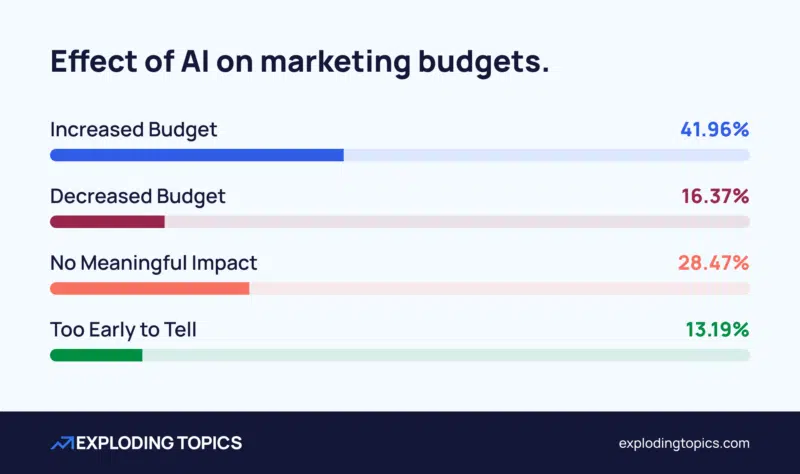
AI has increased the budgets of just under 42% of marketers, while only about 16% report a decrease. 28% say it has had no significant impact so far, and a smaller group says it is still too early to tell. This means that AI does not lead to widespread cost reductions. Instead, it creates pressure to invest, experiment and expand capabilities.
The trend is even more evident when we consider how budgets are reallocated. More than 40% of marketers say AI has already led to major changes in where their money goes, with 28% reporting more minor changes. Even among those who have not yet made changes, many hope to do so within a year. The direction is clear. AI does not add to existing strategies. He actively reshapes them.
Martech Stacks Continue to Grow
At the same time, marketing stacks continue to grow, even as AI tools promise consolidation. About a third of marketers say their stack has increased slightly over the past year, and another quarter say it has increased significantly. Roughly the same share indicates that the rate has remained stable. Very few report a significant reduction.
This may seem to contradict another conclusion. Nearly half of marketers say they have replaced many tools with AI, and another third say they have replaced at least a few. But the contradiction is more apparent than real. What is happening is substitution and expansion, not simplification. AI replaces some point solutions while introducing entirely new capabilities that require additional tools, workflows, and integration.
This dynamic is particularly pronounced in organizations with larger budgets. Teams managing more than $500,000 are significantly more likely to have replaced more tools with AI. This suggests that scale plays a role in how aggressively companies rethink their stack and how quickly they can operationalize these changes.
AI doesn’t shrink marketing teams
The evolution of the workforce reinforces the same trend. About a third of teams report significant growth, and another quarter experience smaller increases. Only a small percentage report a reduction. This goes against the idea that AI will shrink marketing teams. In practice, many organizations appear to be recruiting staff to support new workflows, manage AI-enabled processes, and produce more results.
The variation in team sizes indicates a deeper change. AI isn’t so much replacing marketers as it is changing the way work gets done. Some teams use it to scale content and production with fewer staff. Others are investing in more talent to take advantage of what AI makes possible.

What emerges from the data is a more nuanced picture than the common narrative. AI is not just a cost-saving tool, nor is it a simple replacement for existing technology or talent. It is a force that redistributes resources between budgets, tools and teams.
The marketers who see the biggest changes aren’t necessarily the ones cutting back the most. They are the ones who reallocate resources fastest, experiment most aggressively, and rely on AI as a core part of how marketing works.
Your customers are searching everywhere. Make sure your brand introduces himself.
The SEO toolkit you know, plus the AI visibility data you need.
Start free trial
Start with

This is perhaps the most important takeaway. The impact of AI is not just about efficiency. This manifests itself as acceleration.
Methodology
The survey is based on responses from 1,008 marketing budget decision-makers across the United States, ranging from marketing managers to CMOs, founders and executives. Respondents represented a wide range of budgets, from less than $100,000 to more than $10 million, with the largest share managing between $500,000 and $2 million. The sample was evenly split by gender and included participants from all major regions of the United States, providing a comprehensive view of how AI is affecting marketing organizations today.
Read more about the survey here. (No registration required)



