
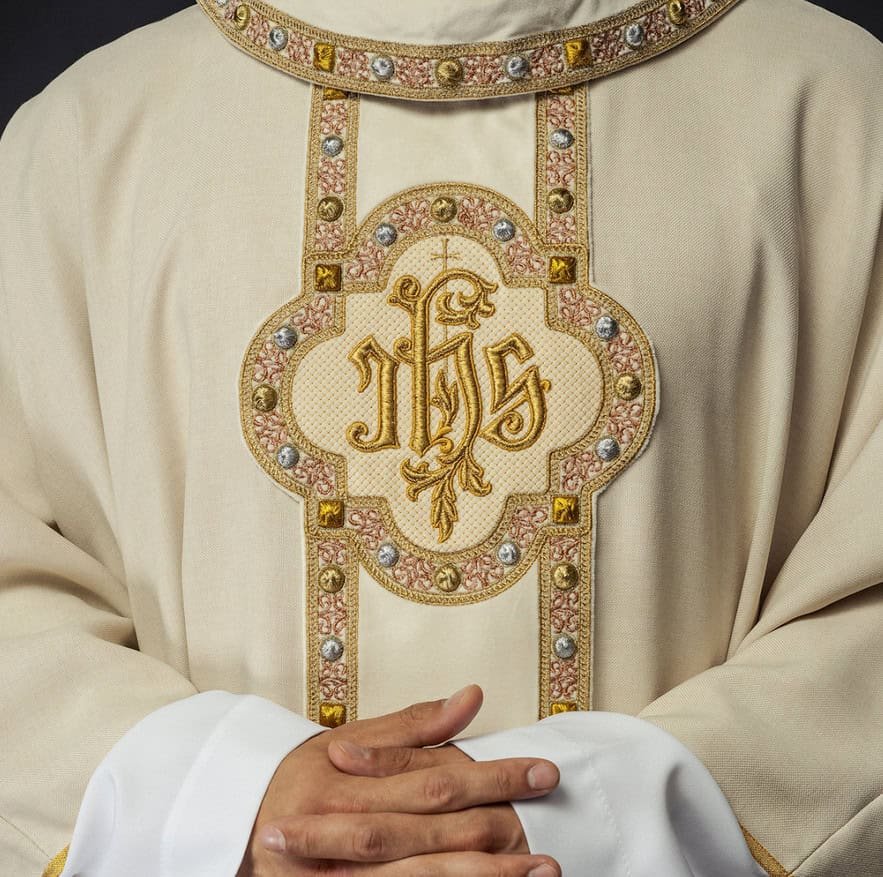
Liturgical vestments, with their richness of color and decoration, are not simple vestments. It is a visual language that speaks of faith, tradition and symbolism. Understanding the designs that adorn these garments means entering a world of deep meanings, capable of enriching our spiritual experience and our participation in celebrations.
Color is one of the most obvious and significant elements of liturgical vestments. Each color is associated with a particular period of the liturgical year or a specific celebration, expressing a different aspect of the Christian faith:
- White: A symbol of purity, joy and glory, white is used during the celebrations of Easter, Christmas, the feasts of the Lord (except those of the Passion), the feasts of the Virgin Mary, angels and non-martyr saints.
- Red: Represents blood, passion, divine love and martyrdom. Red is worn on Palm Sunday, Good Friday, Pentecost, the feasts of the apostles and the holy martyrs.
- Green: Symbolizes hope and eternal life. Green is the color of Ordinary Time, the period of the liturgical year when we meditate on the life of Christ and await his return.
- Purple: Indicates penitence, waiting and preparation. Violet is used during Advent and Lent.
- Black: Traditionally associated with mourning and commemoration of the deceased, black can be used during requiem masses.
- Pink: A less common color, the rose is a sign of joy and mixed hope. It can be used on the third Sunday of Advent (Gaudete) and the fourth Sunday of Lent (Laetare).
Decorative motifs: an alphabet of faith
In addition to colors, liturgical vestments are often adorned with various decorative designs, each with its specific meaning. These designs can be embroidered, woven, or painted onto the garment, transforming it into a work of art that tells biblical stories, expresses theological concepts, and celebrates holiness.
Christological symbols
Christological symbols are those which directly refer to Jesus Christ:
- Lamb of God (Agnus Dei): Represents Jesus Christ as the sacrificial victim for the salvation of humanity. Often depicted with a cross or banner.
- Christogram (IHS, XP): Monograms formed from the first letters of the name of Jesus in Greek (ΙΗΣΟΥΣ).
- Fish (Ichthys): Greek acronym meaning “Jesus Christ, Son of God, Savior”.
- Alpha and Omega: The first and last letters of the Greek alphabet, symbolizing Christ as the beginning and end of all things.
- Sacred Heart: Represents Christ’s infinite love for humanity.
- The Cross: The most important symbol of Christianity, remembering the sacrifice of Christ for the redemption of the world.
Marian symbols
Marian symbols are those that refer to the Virgin Mary, mother of Jesus:
- Read: Symbol of purity and virginity of Mary.
- Star: Depicts Mary as the “morning star,” announcing the arrival of Christ.
- Crown: Symbol of Mary’s royalty as Queen of Heaven and Earth.
- Marian monogram (M, AM): Represents the name Mary.
- Pink: Symbol of Mary’s love and beauty.
Eucharistic symbols
Eucharistic symbols are those which refer to the Eucharist, sacrament of the Body and Blood of Christ:
- Grapes and wheat: Represent the bread and wine used in the Eucharist, which become the Body and Blood of Christ.
- Chalice and Host: Direct symbols of the Eucharist.
- Pelican: According to an ancient legend, the pelican wounds its chest to feed its young with its own blood. For this reason, it became a symbol of Christ sacrificing himself for the salvation of humanity.
Other important symbols
In addition to Christological, Marian and Eucharistic symbols, many other decorative motifs can be present on liturgical vestments:
- Angels: Messengers of God and heavenly servants.
- Saints: Represented with their specific attributes (e.g.: Saint Peter with keys, Saint Paul with a sword).
- Instruments of the Passion: Symbols of Christ’s torment (e.g. crown of thorns, nails, spear).
- Dove: Symbol of the Holy Spirit.
- Tree of life: Symbol of eternal life and the link between heaven and earth.
- Flowers and leaves: Often used as decorative elements, they can have specific symbolic meanings (for example, the palm as a symbol of martyrdom).
- Geometric designs: Circles, squares, triangles and other geometric shapes can represent theological concepts such as the Trinity, divine perfection and cosmic order.
The importance of cultural and artistic context
The interpretation of the designs on liturgical vestments cannot ignore the cultural and artistic context in which they were created. The style, materials and techniques used reflect the artistic traditions of a specific historical period and a specific geographic region. For example, an ornament made in the Byzantine style will have different characteristics than one made in the Gothic or Baroque style.
The role of sacred art
Liturgical vestments are a form of sacred art, one that aims to uplift the spirit, inspire prayer, and communicate faith. Through the beauty of colors, the richness of materials and the depth of symbols, liturgical vestments help us connect to the mystery of God and live our faith experience more fully.
How HaftinaUSA.com contributes to tradition
HAS HaftinaUSA.comwe understand the importance of this rich tradition and are committed to offering a wide range of liturgical vestments that respect the sacredness and beauty of each celebration. From classic embroidered embellishments to modern, minimalist embellishments, each garment is crafted with care and attention to detail, using high-quality materials and artisan techniques. Our goal is to provide priests and ministers with the tools necessary to celebrate the liturgy with dignity and devotion, honoring tradition and inspiring faith.
Practical tips for interpretation
Here are some practical tips for interpreting the patterns of liturgical vestments:
- Observe carefully: Pay attention to the colors, symbols and decorative patterns on the clothing.
- Let us consider the liturgical context: Keep in mind the time of the liturgical year or specific celebration.
- Find the meaning of the symbols: Consult books, websites, or experts to increase your knowledge of Christian symbols.
- Think about the message: Ask yourself what message the liturgical vestment wants to communicate and how it can enrich your experience of faith.
- Enjoy the beauty: Be inspired by the beauty of sacred art and its ability to uplift the spirit.
Liturgical clothing and accessories: an expression of faith and devotion
The choice of liturgical vestment, whether a sacred vestment for the priest or an accessory for the altar, represents an act of faith and devotion. Every detail, from the type of fabric to the embroidery, helps create an atmosphere of sacredness and respect during the celebrations.
The importance of material quality
The quality of the materials used to make liturgical vestments is fundamental. Refined fabrics like silk, brocade and velvet lend elegance and solemnity, while gold and silver thread embroidery adds a touch of refinement. The care taken in the choice of materials is not only an aesthetic question but also a sign of respect for the sacred.
The value of craftsmanship
Many liturgical vestments are handmade by skilled artisans who pass down ancient embroidery and weaving techniques from generation to generation. This know-how gives added value to the garment, making it a unique and precious piece. Choosing a handmade garment means supporting local craftsmanship and preserving a cultural heritage of inestimable value.
The evolution of liturgical conceptions over time
The decorative patterns of liturgical vestments have evolved over the centuries, reflecting the cultural and artistic changes of different eras. From simple early Christian symbols to elaborate baroque decorations, each historical period has left its mark on sacred art. The study of the evolution of liturgical conceptions allows us to better understand the history of the Christian faith and its relations with culture.
Conclusion: an invitation to contemplation
Interpreting the designs of liturgical vestments is an invitation to contemplation and prayer. It is a way of connecting to the richness of the Christian tradition and deepening our understanding of the faith. The next time you participate in a liturgical celebration, carefully observe the vestments of the priest and ministers of religion. You will discover a world of hidden meanings, capable of enriching your spiritual experience and bringing you closer to God.



