
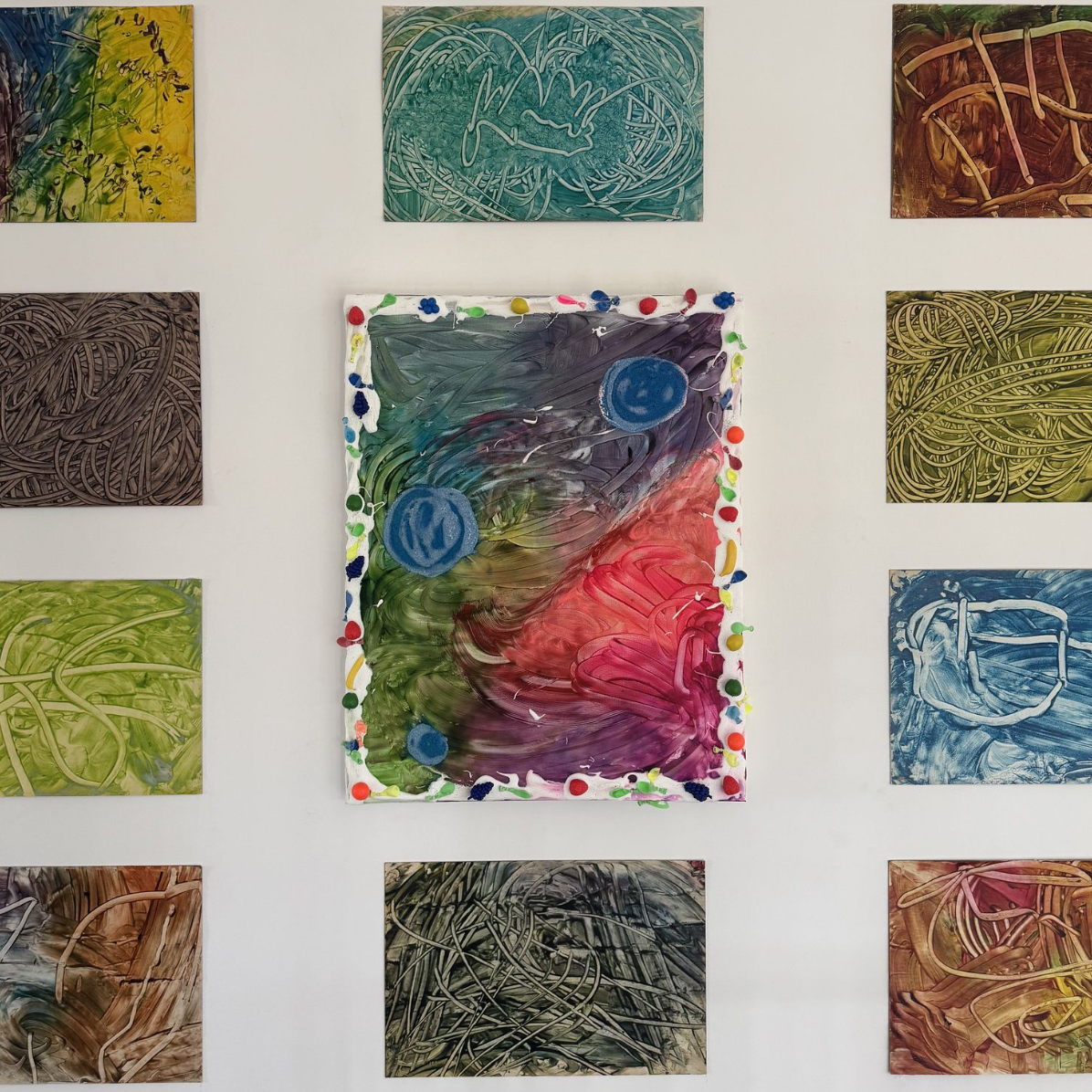
When Brian Belott began putting together “Upside Down Zebra” at the Watermill Center in Water Mill, New York, he already had Sivan Lavie in mind. He had been looking at her work on Instagram since 2016, attracted by the intensity of its color and the strangeness of its materials. He was also enthusiastic about publications where she made art with young children, with the same seriousness and pleasure that she brought to her own paintings. This combination stayed with him. When they finally met in person in 2023, at an exhibition curated by their mutual friend Chris Martin at the Anton Kern gallery in New York, he invited her to participate in the exhibition shortly after their first conversation.
The soon-to-close “Upside Down Zebra” ran from June 2025 to late May 2026 and was the largest exhibition in the Watermill Center’s history, filling six interior galleries with nearly a thousand works from the Rhoda Kellogg International Child Art Collection as well as new and existing works by more than forty contemporary artists. The institution, founded by Robert Wilson and one of the most respected sites of experimental practice in the country, attracted participants including Carroll Dunham, Christopher Wool, Richard Tuttle, Katherine Bernhardt, and Ugo Rondinone.

Lavie’s paintings easily found their place in this company. His large dots and circles, saturated and floating on a white background, have been the common thread of his practice for more than a decade, and the context of “Upside Down Zebra” suited them precisely: it was a work that had always operated on the same frequency as the children’s drawings around it, sharing their frankness and physical confidence while carrying the full weight of a trained and rigorous studio practice. The exhibition made visible something that had always been true in Lavie’s paintings: that the freedom they contained was not a starting point but an accomplishment.
The same season, she organized and presented “Confessional Flowers,” a solo at the Satellite Art Gallery in New York, founded by artist and gallerist Brian Andrew Whiteley. The exhibition was entirely his own: designed, curated and installed by Lavie, bringing together paintings, sculptural works and installations in a unified environment rather than a grouping of individual objects. The two exhibitions held in the same year – one an invitation to one of the most prestigious institutional surveys of contemporary American art, the other an entirely self-directed solo at the heart of New York’s independent scene – gave a clear picture of Lavie’s position.
She arrived in New York with a body of work built steadily and seriously over nearly a decade. Born in Haifa in 1992 and raised between Zurich and London, she returned to Israel in 2016 and earned an MFA with distinction from the Bezalel Academy of Art and Design, the country’s premier fine arts institution. The work she has produced over the years has already found its audience. A year later, she moved to the Central Bus Station, one of Tel Aviv’s busiest and most distinctive architectural environments, for a two-month residency that produced “Let There Be Glitter.” The exhibition took up an entire gallery space on the fifth floor, and Lavie I filled it with large unstretched white canvases hung and freestanding throughout the room, each bearing its dots, lines and arcs painted in bold acrylic colors. The scale was total: the paintings enveloped the columns, lined the corridors and spilled into the public-facing windows, visible from the station’s indoor shopping center below. A sculptural work sat on the floor in the center and the opening included a live performance. The exhibition was reviewed at length by Portfolio Magazine and documented by photographer Youval Hai. It closed a few days after opening, due to the COVID-19 pandemic. Lavie chose not to view this as a loss.
Two years later, she presented “My Lucky Heart” at the Vitrine Magasin III bookstore in Jaffa, the Israeli outpost of the internationally renowned Stockholm institution Magasin III, one of Scandinavia’s most respected contemporary art museums. The scale here was the opposite of that of the central bus station: a storefront, a single compressed storefront. demanding that the work operate at close range and hold a spectator passing in the street. Lavie’s response was characteristically precise, a concentrated arrangement of his signature forms that transformed the constraint of format into an argument for the power of little things to open wide open spaces. The presentation took place in conjunction with a solo exhibition by Polly Apfelbaum, one of the most important American artists working with color, pattern and abstraction. Taken together, the two exhibitions reveal the full range of Lavie’s ambition: she could fill a warehouse and she could fill a display case, and in both cases the work was entirely itself.
In 2023, she had started serving as a commissioner. “Dream Gurlz” at Binyamin Gallery in Tel Aviv’s Kiryat HaMelacha art district was an exhibition with a stated position and a specific target. The exhibition The statement makes it clear: the exhibition was born out of a desire to expand the space and legitimacy available in the local art scene for works whose primary purpose is aesthetic, which is sometimes considered trivial in Israel. Lavie has assembled an international roster of eight artists from Israel, Germany and the United States, including Karen Dolev, Jessica Petrilak, Shani Pri-Nes, Clara Kaiser, Lee Raz, Shahaf Shua and Alexandra Zuckerman, united by their shared investment in the aesthetic, the feminine, the colorful and the handmade. The exhibition created what its statement describes as direct bridges between international artists with similar goals, in an established gallery space in Tel Aviv. Lavie was not asking permission to do joyful work. She placed it in the center of the room and invited the art world to catch up.
Ohad Shaaltiel, then educational director of the Tel Aviv Museum of Art, saw in this exhibition and in Lavie’s practice exactly what he necessary for a one year old child workshop program that he developed at the museum. He invited her to design and direct it. This connection was no coincidence: The qualities that made her compelling to Shaaltiel were the same ones that had caught Belott’s attention on Instagram years earlier and would ultimately bring her to Water Mill.
For Lavie, working with children has never been separate from what she does in the studio. She has been teaching since 2017, when she received the Amitei Bezalel Rothschild Foundation Fellowship while studying for her MFA. She has since taught in schools, museums, and preschools in Israel and the United States, bringing her own playful and free art practices to early childhood and elementary education. She is a true experimental teacher, preferring the atelierista model which allows children to explore art materials in an open-ended way, without a specific product in mind. His teaching and artistic practice proceed from the same beliefs: that color communicates directly with the body, that making can be a form of true knowledge, and that there is no meaningful hierarchy between the instincts of a child holding a paintbrush and the intentions of a trained artist. The paintings she creates are attempts to reduce this distance. Children’s workshops are trying to close it the other way.
She is now based in New York, publishing poetry and fiction in Hobart, teaching children and making paintings. The circles continue to appear. They’re not going anywhere.



