

AI research has a big trust problem. Consumers use it to compare products, research suppliers, and narrow down their options, but many don’t trust the answers they get.
Sixty-five percent of Americans have used AI search in the past six months, but only 15% said they trust it a lot, according to a study by Yelp. This created a confidence cliff. AI is gaining influence over purchasing decisions faster than consumers are gaining trust in the technology.
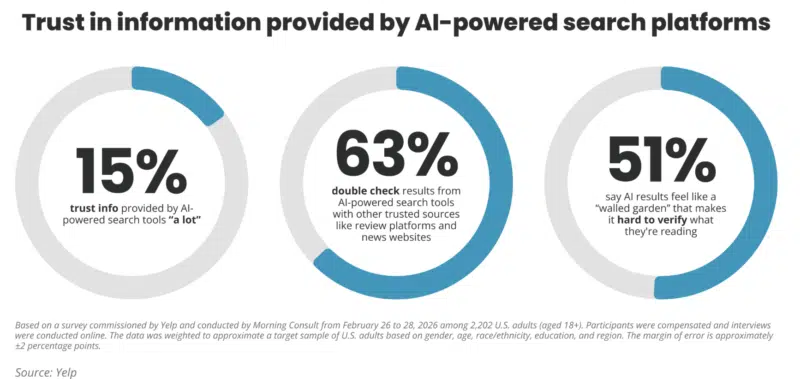
This change creates a new challenge for marketers. Consumers may be wary of AI, but they still use it to compare products, research suppliers, and narrow down their options. Brands find themselves increasingly judged on recommendations that they do not control.
Sherry Smith, president of retail media at Criteo, said AI is already changing the way shoppers evaluate products.
“We’re seeing consumers use AI to compare products,” Smith said. “It’s become part of the discovery process and how buyers compare prices.”
Trust is also an issue for B2B
And this doesn’t just happen in retail.
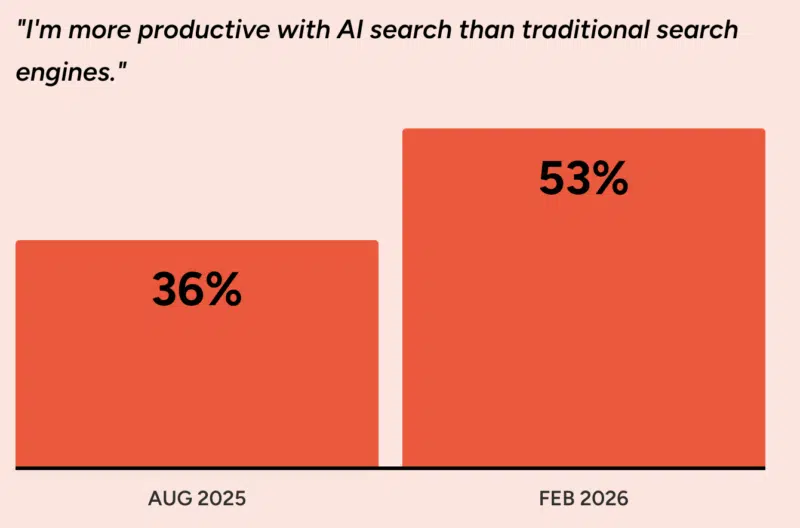
In B2B software purchasing, 53% of buyers said AI search made software research more productive than traditional search, according to “AI Research Analytics Report 2026.” The report highlights how this radically changes the discovery phase:
“Buyers who once needed weeks to compare vendors can now use their favorite AI chatbot to get a usable overview in minutes. And they don’t just start with a prompt. They leverage chat to make comparisons and, ultimately, decide.”
In many cases, buyers now encounter AI recommendations before encountering vendor marketing.
The lack of trust is harder to ignore because AI pushes buyers to make decisions much faster.
“The path to purchase is getting shorter and shorter,” Smith said. “It’s less linear and more decision-driven. As buyers arrive from these environments, they get closer to their final choice.”
Fewer opportunities for marketers
This means lost opportunities to shape the buying journey. Instead of moving from the homepage to the category page to the product page, shoppers are increasingly arriving at the decision point.
It also changes where that first interaction occurs.
“Our research shows that 70% of AI-referenced users land on product detail pages,” Smith said. “We need to make these pages as strong as possible because, for many referred visitors, this is their first interaction with the brand.”
For years, marketers have treated product pages as the last step before conversion. AI makes it the new gateway. Now, for a growing number of shoppers, the product page does the job that the homepage used to do.
Three-quarters of Americans would lose confidence in AI shopping results if those results were sponsored, according to the Quad/Graphics report. “The New Rules of Trust in Retail in the Age of AI.”

This is why the confidence cliff is important. Consumers can rely on AI recommendations, but many still question whether those recommendations serve the buyer, the platform, or the advertiser.
The question then: “Are we building experiences that earn and deserve consumer trust?” »
Smith compares today’s AI adoption curve to the early days of social commerce.
“Buyers need time to familiarize themselves and become familiar with AI,” she said. “We’ve seen the same trend with social media. People still trust familiar retailers and shopping environments, but that trust will increase over time.”
Your customers are searching everywhere. Make sure your brand introduces himself.
The SEO toolkit you know, plus the AI visibility data you need.
Start free trial
Start with

Smith argues that trust increases when AI feels helpful rather than intrusive.
“Brands have the opportunity to create moments of serendipity,” Smith said. “If a retailer understands what a shopper is looking for and can recommend something truly relevant, it feels personal and helpful rather than intrusive.”
The crisis of confidence is not a future problem. Consumers already rely on AI to make decisions, compare options and narrow down their choices. The brands that win will be those that turn AI visibility into consumer trust.



