

Ask any paid search manager who has tried to use an AI agent to do something genuinely useful with a Google Ads account and you’ll hear a version of the same story. They exported the performance data, pasted it into a chat window, got a solid response, then did the exact same thing the next day.
Export, paste, repeat: this is not automation. It’s the same manual work you did before, done in a different window.
AI tools are not the problem. Any of the big ones can do solid analysis when the right data is in front of them.
The problem is to transmit this data to them live, up to date and without an intermediary human copying it. This is why most PPC accounts in 2026 still operate almost exactly the same as they did before anyone started talking about agents. Call it the data wall.
The Problem Behind “We Just Need Better Prompts”
Every advertising platform is a silo by default. Google Ads records a conversion. Your CRM records whether this prospect is qualified. Your inventory system records whether the product that caused that click is still on the shelf. None of them speak to each other without deliberate plumbing.
PPC managers have been bridging this gap manually for years: weekly exports, cross-referenced spreadsheets, dashboards that are outdated Monday morning.
This was achievable when a human performed the bypass on a set schedule. This becomes a structural problem when execution is entrusted to an agent who must act in real time.
Take a keyword showing healthy volume, acceptable CPA, and in-range CVR, all according to Google Ads. In HubSpot, these same conversions are labeled as disqualified leads: wrong territory, no budget, totally incorrect company size. The agent has no way of knowing this. He continues to bid. The budget continues to spend. And the problem only surfaces when someone does the monthly review.
This is a data access problem, not an incentive problem. Better prompts don’t solve the problem. But a better pipeline does.
MCP gives your AI agent access to data and skills
The Model Context Protocol (MCP) is an open standard that allows AI clients to connect to external tools and data sources without custom integration for each. Before MCP, having an agent read Google Ads, your CRM, and an inventory system meant creating and maintaining three separate connectors, with the load increasing each time you added a source.
MCP standardizes the handshake. A platform publishes an MCP server once, and any compatible AI client — Claude, ChatGPT’s agent mode, your team’s custom agent — can connect to it.
Google has already open sourced its MCP Ads API server on GitHub, which allows agents to run Google Ads Query Language (GAQL) queries directly on live account data. The infrastructure problem that has held up most agentic PPC work in the real world is finally solved at the platform level.
What opens up when data finally flows
The CRM gap closes first. An agent connected to both Google Ads and HubSpot can pull last month’s conversions, compare them with the CRM layout, identify keywords producing disqualified leads, and reduce bids on those sources, on a schedule, without a human compiling the report. A loop that once consumed half a day now runs automatically.
Inventory creates the same type of blind spot. An agent connected to Shopify can check inventory levels before weekend campaigns go live. When a SKU falls below the threshold, the corresponding product group is paused before traffic reaches a page that no longer converts.
Even the work of the data pipeline itself becomes faster.
At a recent “PPC Town Hall“ episode, Lars Maat – a PPC expert and founder of an agency in Rotterdam – described creating a Python pipeline without any prior Python experience, connecting the Google Maps API, Google’s Things To Do functionality and Ahrefs to generate optimized landing pages for a parking client to identify nearby attractions, check search volumes and feed content into a generator.
The whole thing was live within two weeks. The only constraint was presenting the right data to the AI and not knowing what it could do.
Access without guardrails is its own problem
This is where things get interesting and where most of the MCP hype skirts a real problem.
Write access to a live Google Ads account, in the hands of a probabilistic linguistic model, without institutional constraints, constitutes a new category of risk. An agent capable of suspending a campaign needs defined parameters: what threshold triggers the action, who is notified before it is triggered, what types of campaigns require human approval. These settings do not exist in the AI tool. They need to be built around that.
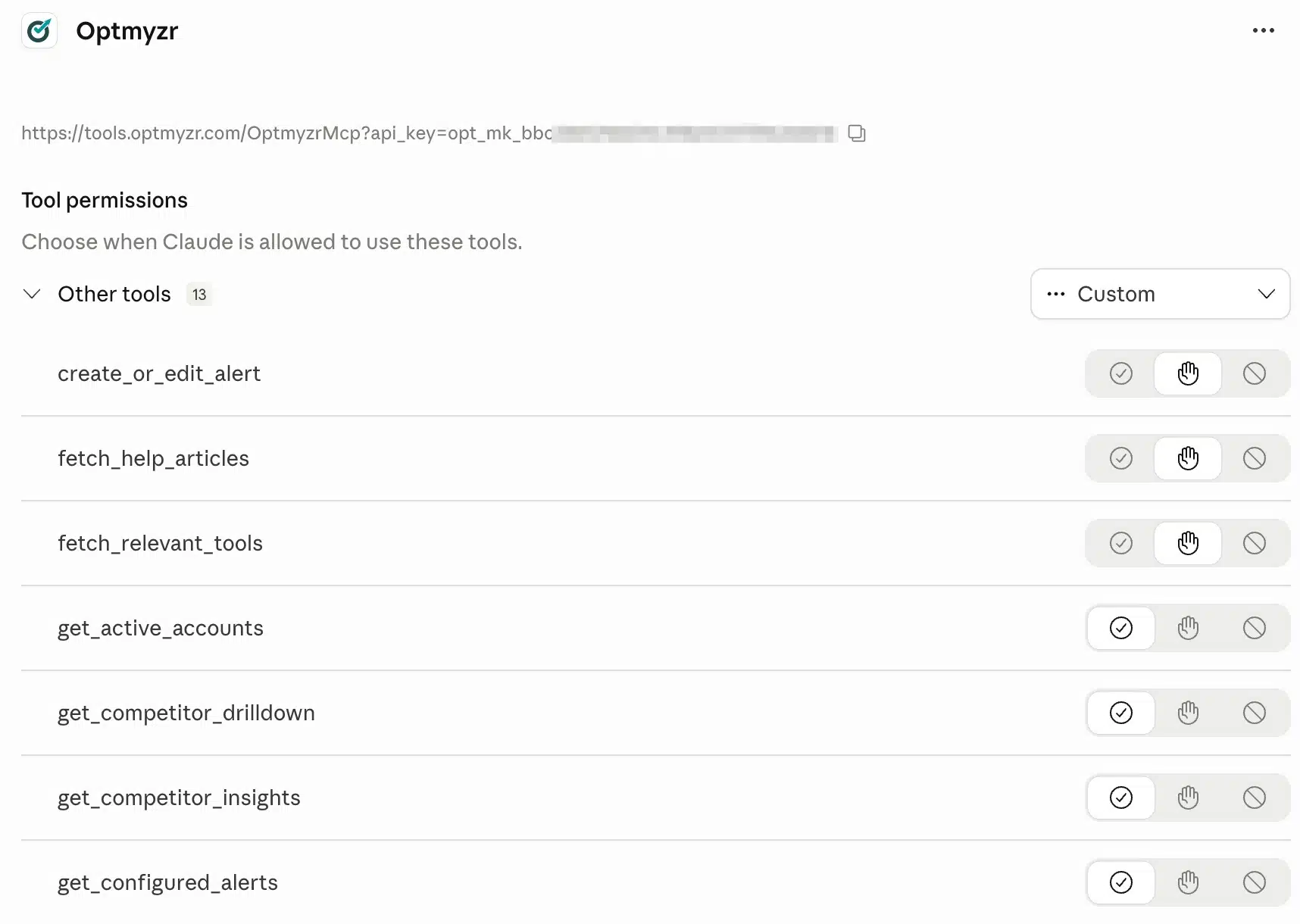
Advertisers can grant granular permissions to the Optmyzr MCP to maintain control over what the connector is allowed to do on its own, what it can never do, and what it can do with human approval.
Advertisers can grant granular permissions to the Optmyzr MCP to maintain control over what the connector is allowed to do on its own, what it can never do, and what it can do with human approval.
On another “PPC Town Hall“ In this episode, Ann Stanley — founder of Anicca Digital and one of the UK’s most experienced paid media practitioners — described effective AI deployment as a sandwich: humans at the front who understand the goal and can give precise instructions, humans at the back who review the outcome and decide what gets shipped, and AI who manages execution in the middle. The quality of what comes out depends on the quality of what goes in. And on whether the middle layer has constraints.
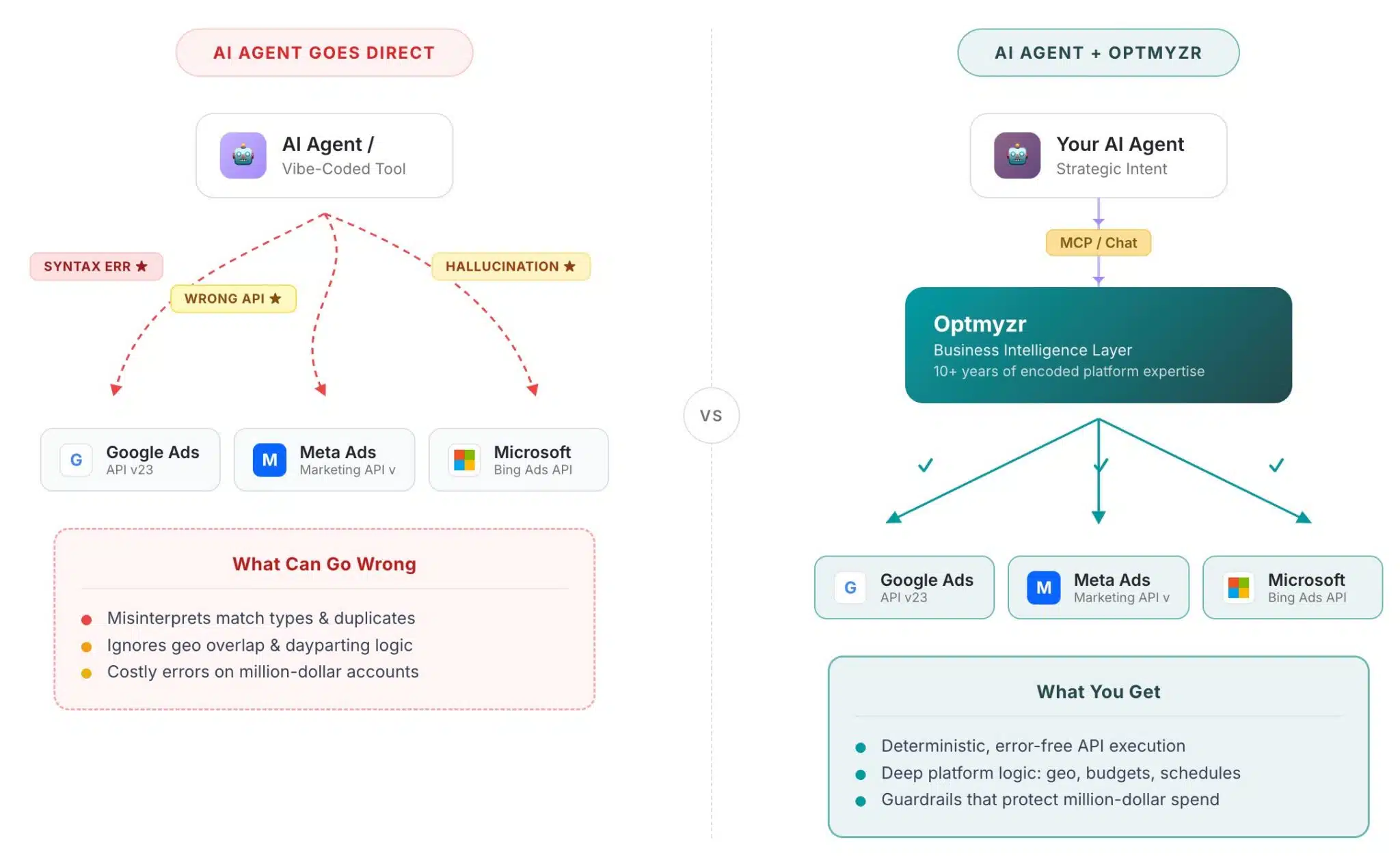
This is where raw API access is no longer enough.
Google’s open source MCP server is a good piece of infrastructure. But it’s not a safety net. It will happily execute any GAQL query and mutation constructed by the agent, and if the agent hallucinates a campaign ID or chooses the wrong analysis window, the ad account absorbs the consequences.
LLMs are probabilistic. Advertising platform APIs are not. So there has to be something in between.
Why Optmyzr created its own MCP
We’ve spent over a decade coding the real behavior of Google Ads: not just what the API exposes, but also the interdependencies between parameters, the edge cases around campaign types, the nuances of what makes a “duplicate keyword” a true duplicate versus a false positive. This work resides in Optmyzr as a business intelligence layer. Our MCP connector allows your AI agent to borrow it.
When Claude, ChatGPT, or your team’s custom agent logs into the Optmyzr MCP, they have access to the same Sidekick features your team uses in Optmyzr: pull PPC performance reports with rich filtering and segmentation, surface configured and triggered alerts, create and edit alerts, retrieve merchant feed details, summarize portfolio health on each active account, and – this is what most people miss – generate and execute a marketing strategy. Complete rules engine from simple English. description of what you are trying to accomplish.
This is important for three reasons that most DIY setups lack:
- Strategy from a sentence, executed in Optmyzr. MCP’s Rule Engine feature takes a natural language instruction (“find campaigns where CPA has drifted 20% above target over the last 14 days and write a bid adjustment strategy”), generates the corresponding Rule Engine strategy, runs it on your account, analyzes the results, and returns recommendations. The LLM writes the intention. Optmyzr’s deterministic rules engine does the job. This is the layer of execution and control that ad platform raw MCPs do not have.
- Portfolio-wide multi-account analysis. Sidekick, in the Optmyzr UI, looks brilliant in the context of a single account and a single page. MCP is where you go when the question is “which of my 80 accounts are trending upward in negative keyword waste this month?” An AI client connected to the Optmyzr MCP can deploy to all accounts in your profile in a single prompt. This is the main reason why agencies connect their agents to the Optmyzr MCP rather than a raw connection to the Ads API.
- Guardrails inherited from Sidekick. Every action taken through Optmyzr MCP runs under the same permissions and workflow logic as using Sidekick directly. The agent analyzes, develops strategies, alerts and writes proposed changes; humans or existing Optmyzr approval flows ship changes. It’s the “safety sandwich” Stanley describes, built into the product rather than bolted on.
The end result is an AI agent that works in your wallet with the reach of an API, the judgment of a platform that existed in this space before AI agents were a category, and a security posture that doesn’t require you to build your own circuit breakers.
A practical starting point
If you want to experiment with read-only access on raw ad platforms, Windsor.ai’s MCP integration and Zapier are the quickest on-ramps. If you’re comfortable managing your own guardrails, Google’s open source Ads API MCP server on GitHub gives you fine-grained GAQL control at the cost of building the security layer yourself.
If you manage client accounts where a dud is unaffordable – or you simply want your AI agent to think about your entire portfolio with the judgment of a senior PPC strategist – the Optmyzr MCP is the quickest path to an agent whose keys it is truly safe to hand over. It works with Claude Desktop (via custom connectors or manual configuration), Claude Code, ChatGPT (via developer mode apps), and any MCP compatible client. And you can set it up in minutes: generate an API key from the MCP integration panel in your Optmyzr settings, paste the server URL into your AI client and your agent operates on every active account in your Optmyzr profile.
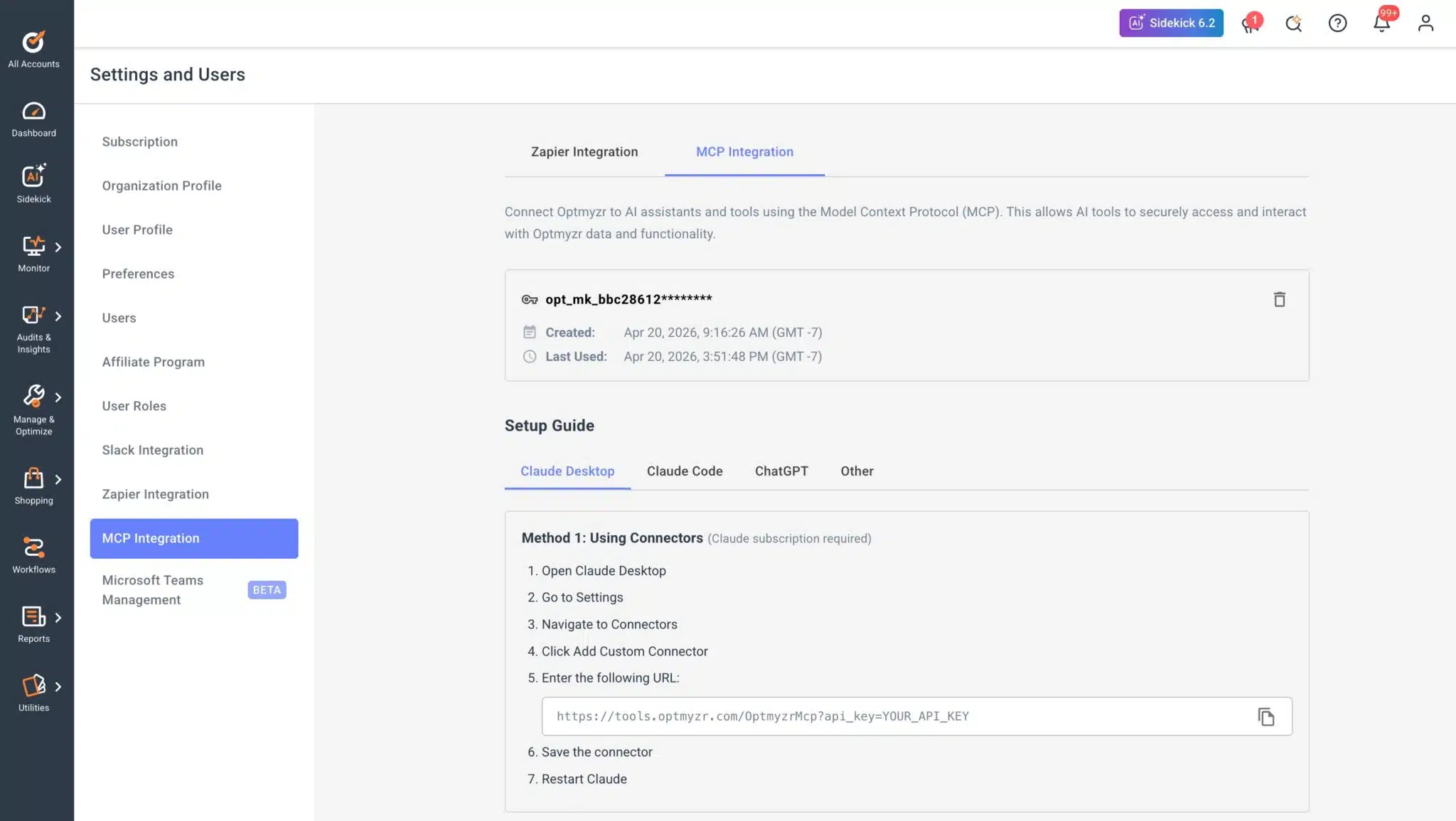
Complete MCP Setup Guide and instructions.
The data wall is collapsing one way or another. The question is whether your agent goes through it with a plan or a prompt and a prayer.



