

Ninety percent of CX organizations are now testing or deploying AI, according to Five9’s “2026 Business Leaders CX Report.”
Overall, the report finds that organizations are largely in agreement on AI adoption, but sharply divided on governance, deployment strategies and how to use it in customer service without creating new complexity or eroding customer trust.
AI adoption may be widespread, but there is still no consensus on how best to deploy it. Respondents are almost evenly split across end-to-end platforms, hybrid environments, and best-of-breed solutions, indicating that no standard AI architecture is emerging in the industry. Organizations reach the same destination by very different routes.
The same lack of consensus appears in infrastructure. While 84% of organizations are transitioning from on-premises systems to the cloud, most continue to operate hybrid environments. Rather than rushing to complete cloud migrations, many appear to be preserving flexibility as AI models, vendors and customer expectations continue to evolve.
This focus on flexibility extends to the AI platforms themselves. Many organizations are creating environments that allow them to choose different models for different tasks instead of relying on a single vendor. The goal is not so much to find a single platform that does everything, but to maintain the freedom to adapt as technology evolves.
Trust is an operational challenge
Trust is becoming one of the biggest operational challenges.
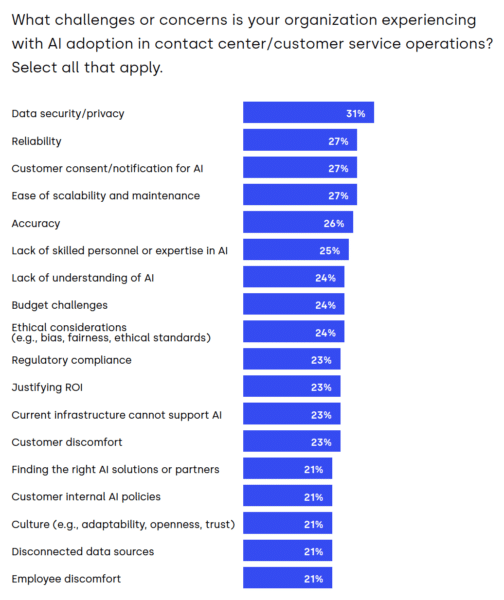
Data security tops the list of concerns, cited by 31% of respondents. Reliability, scalability and customer consent each concern 27% of respondents, while ethics, regulatory compliance, infrastructure, AI expertise, budget constraints and customer discomfort all top 20%. Only 4% say they have not encountered significant implementation difficulties.
Organizations are also selective about where they deploy AI first. The most common implementations focus on improving existing operations rather than reinventing customer experiences.
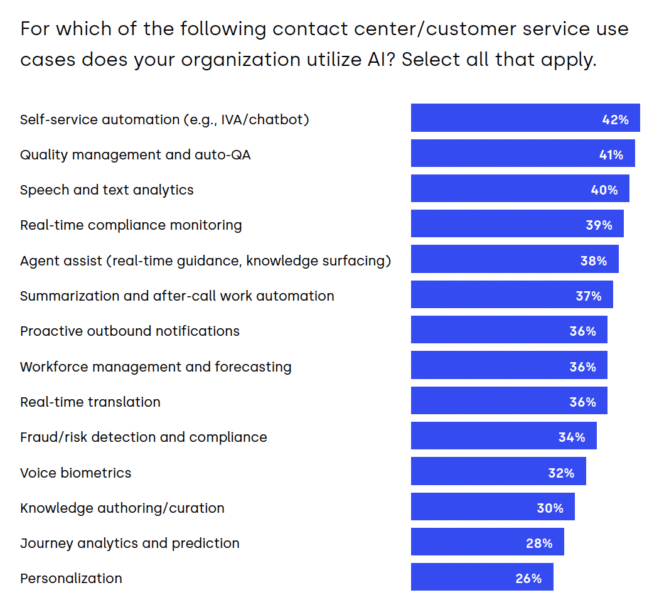
Self-service automation leads adoption at 42%, followed by quality management and automated quality assurance (41%), voice and text analytics (40%), real-time compliance monitoring (39%), and agent assistance (38%). These applications improve efficiency, consistency, and employee performance while integrating with workflows that businesses already understand.
Customer-facing deployment remains weak
Customer-facing capabilities are advancing more gradually. Knowledge creation deployment is 30%, journey analysis is 28%, and personalization is 26%. These use cases require richer customer data, stronger governance, and greater trust in AI-generated decisions, making them more difficult to deploy at scale.
This suggests that organizations are proving the operational value of AI before embarking on more sophisticated customer experiences.
Infrastructure decisions tell a similar story. Today, 74% of respondents operate hybrid customer service environments. Only 16% have fully cloud-based deployments, while 10% remain entirely on-premises.
Moving between these environments remains a challenge. Data security and privacy issues lead migration issues at 36%, followed by integration with existing IT infrastructure (35%), data migration and reliability (34% each), customer experience disruptions and regulatory compliance (33%), software adaptation (32%), implementation costs (31%), and technical support, scalability and staff training (29% each). Only 4% of organizations report no migration issues.
Taken together, these results suggest that flexibility is becoming an element of strategy. As AI capabilities rapidly evolve, organizations appear reluctant to engage in technology decisions that could limit their future options.
10X your SEO with Semrush for business.
The world’s most powerful SEO platform, built specifically for businesses.
@media (maximum width: 768 px) { .headline-responsive { font-size: 30px !important; line-height: 1.3 !important; } }
Changes in the organization of customer service work
The report also highlights a broader shift in the way customer service work is organized.
Among U.S. respondents, 45% cite increased efficiency and productivity as the biggest benefit of AI. 42% say they have improved decision-making, while 42% say AI has improved customers’ perceptions of their organization.
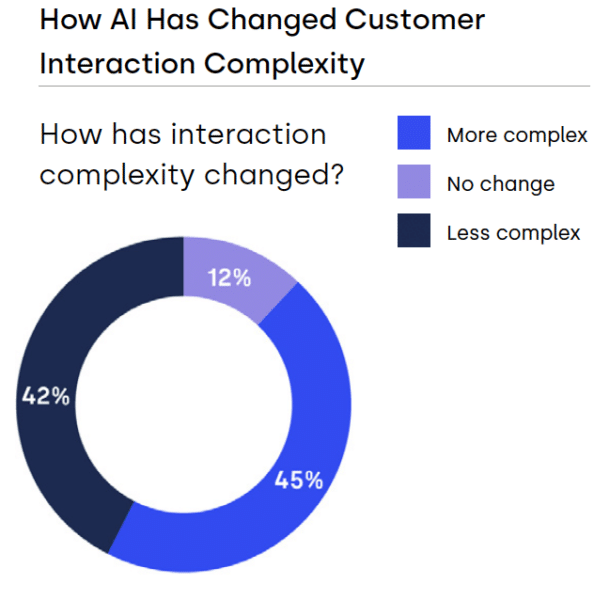
AI also changes what agents spend their time doing. Overall, 45% of respondents say AI provides better data-driven decision support, while 44% say it helps agents handle exceptions and judgments. Routine tasks such as documenting interactions, retrieving knowledge, translating conversations, summarizing customer interactions, and processing self-service requests are increasingly handled by AI, allowing agents to focus on situations that require context, empathy, and human judgment.
Organizations also see financial returns. For every AI use case measured, about nine in 10 respondents report a positive ROI, indicating that the debate has largely shifted from whether AI creates value to where it creates the greatest value.
The findings depict an industry entering a more mature phase of AI adoption. Deploying AI is now table stakes. Competitive advantage lies in operational execution: establishing governance that customers can trust, giving teams the flexibility to adapt as AI evolves, and using technology to improve customer service.
The report can be downloaded here. (Registration required)
The position AI adoption hits 90% as CX deployment paths diverge appeared first on MarTech.



