
This article was sponsored by Victorious. The opinions expressed in this article are those of the sponsor.
A year into the shift to AI search, the marketing industry is full of confident perspectives on the factors that impact AI visibility. But we have seen very little data to support commonly held assumptions.
We wanted to see what correlations we could find between traditional search performance and AI mentions and citations. So we built a study to see if we could discover evidence-based recommendations from the data.
The study methodology: comparison of the performance of traditional search and AI search
To compare brand performance in traditional search versus AI search, we needed a dataset capturing both signals for the same companies over the same time period.
We built it in four phases.
Step 1: Determine the brand set.
We selected a representative sample of 177 brands across five verticals: healthcare, SaaS, financial services, e-commerce/retail, and legal services.
Step 2: Capture the AI visibility signal.
For each brand, we tested specific vertical prompts across eight AI platforms: ChatGPT, Perplexity, Gemini, Google AI Overview, Google AI Mode, Microsoft Copilot, Claude, and Meta AI. This gave us 107,011 AI responses to analyze.
For each response, we recorded two things: whether the platform named the brand (mention) and whether it was linked to the brand’s domain as a source (citation).
Step 3: Extract organic performance data.
For the same 177 brands, we tracked domain-level organic performance in Semrush during the first quarter of 2026, including traffic trends and authority scores.
Step 4: Cross-reference the two datasets.
We combined AI viewability data with organic data so that each brand has three comparable metrics: mention rate, citation rate, and authority score. This structure allowed us to examine the relationship between traditional ranking signals and AI visibility, and determine whether these factors were more or less related across different verticals.
Why we tracked mention rate and citations separately
One metric does not capture AI visibility, so we tracked both mention rate and citation rate as separate signals. For example, a brand may be often mentioned and rarely mentioned, or often mentioned and rarely mentioned. Tracking the two separately, rather than lumping them into a single “AI Visibility” score, ended up being at the heart of the nuances we could draw from different verticals.
Finding 1: Most brands have no mention of AI
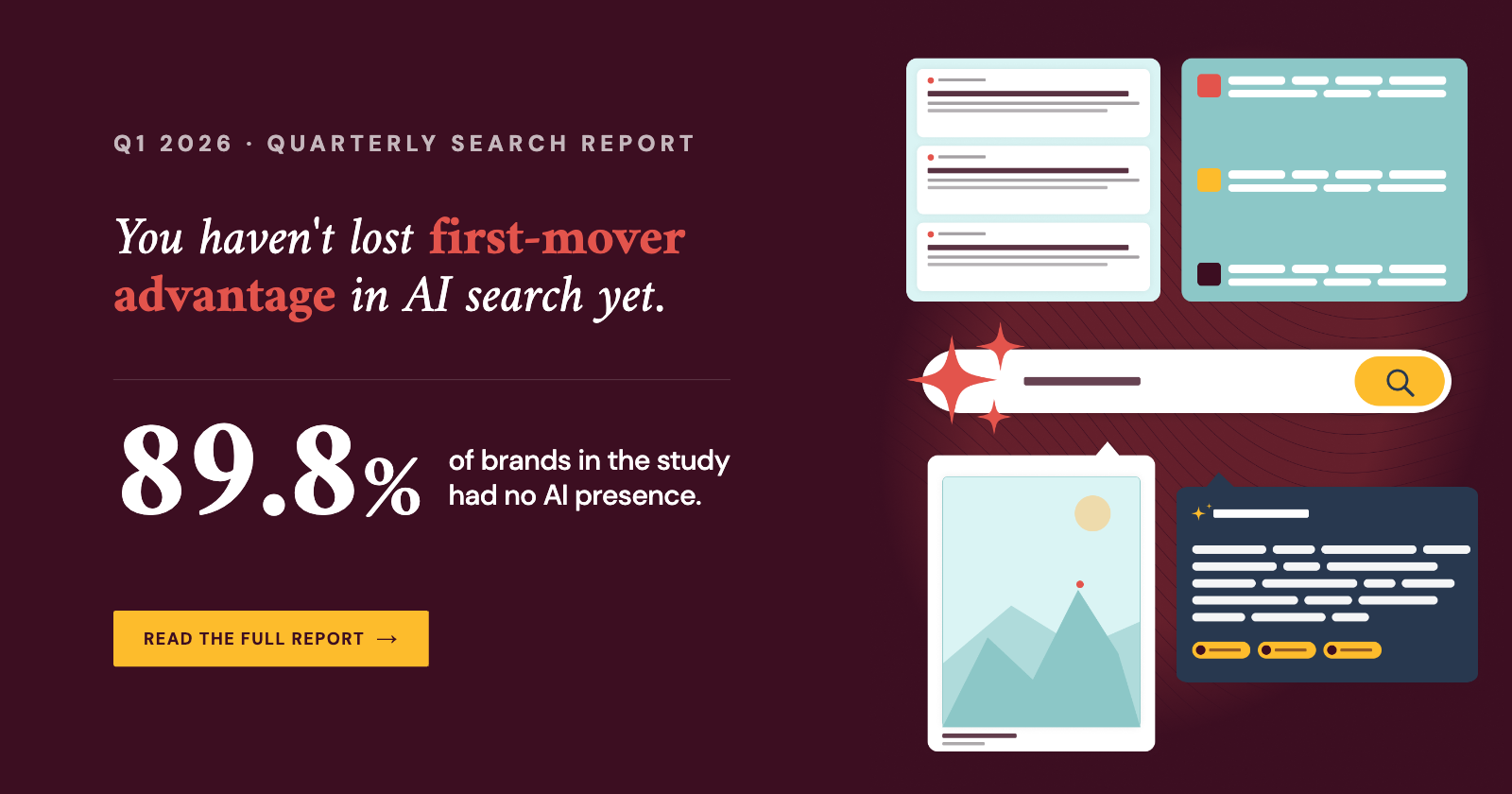
Of the 177 brands in our dataset, only 18 had an AI mention rate above zero in Q1 2026. This means 89.8% of brands we tested were largely absent from AI search on the eight platforms we measured. They were not mentioned. Brands were not mentioned in relation to the responses, as sources or examples.
This runs counter to much of the current industry discussion, which treats AI visibility as a race already well underway. Our data shows a very different picture. For a very large number of brands, the race has not yet started.
The fact that only 18 of the 177 brands in our research recorded any mention of AI indicates that brands willing to take AI visibility seriously will now be competing against a small number of incumbents in their sector, not the entire category.
Finding 2: AI visibility models vary by vertical
Once we broke down the data by vertical, three distinct patterns emerged.
Mentioned and Cited: Healthcare Brands, SaaS and Financial Services

Brands from these three verticals were consistently mentioned and cited, but for different reasons. Healthcare brands benefit from clear entity identifiers such as names, locations, specialties and network affiliations, which reinforce the signals that AI platforms use to assess expertise and authority. SaaS brands are typically featured on third-party platforms like G2, Reddit, and LinkedIn, where products are discussed by users and reviewers. Financial services enjoy a strong editorial media presence on platforms like MarketWatch, Bankrate, and NerdWallet, which are common sources that AI platforms turn to for financial questions.
Financial services was also the only vertical where citation slightly exceeded mention, suggesting that AI platforms trust content slightly more than specific brands.
In each case, the brands that appear have something that AI platforms can attach brand identity to: structured data, third-party validation, or editorial coverage. Marks that do not appear are usually missing one or more.
Mentioned more than mentioned: e-commerce and retail brands

E-commerce has the largest gap in our dataset. AI platforms recognize these brands but pull their sources from elsewhere, typically marketplaces, aggregators and review sites, rather than the brands’ own domains.
For these brands, recognition comes from their presence in the market and their familiarity with consumers. The biggest challenge for e-commerce brands is to provide AI platforms with quotable content on their own domain, instead of leaving the field to Amazon, Reddit and review aggregators.
Cited but rarely mentioned: legal services

Legal services showed the opposite trend to e-commerce brands. AI platforms regularly source content from legal sites, but they rarely credit the company behind the article.
Bridging this gap means creating entity signals that connect a piece of content to a recognizable business.
Results 3 to 4
Each AI platform relies on a different set of sources.
ChatGPT, Perplexity, Gemini and Copilot display preferences for specific content types. THE the full report details mention rates by platform and vertical, so you can focus on the AI platforms your buyers actually use.
Personalization could worsen the initial visibility of AI.
Google’s Personal Intelligence update pulls signals from a user’s Gmail and photos into AI mode responses, directing results toward brands the user has already encountered. If this effect holds, brands that win a user’s first AI interaction on a topic could increase their visibility faster than later participants. The full report reviews what we’re looking at in the second quarter to test this.
Key to remember
If you take nothing else from this data, remember that you haven’t lost the first-mover advantage. With only 18 of the 177 brands we measured getting mentions in AI search, there’s still white space in your vertical waiting to be claimed.
You can read the full quarterly research report for Q1 2026 on our site.
Image credits
Featured image: Image from Victorious. Used with permission.
In-Post Images: Images from Victorious. Used with permission.



