

Coca-Cola and its partners offer a new measurement framework, Universal Media Measurement (UMM), to help marketers compare the effectiveness of paid, owned, earned and shared media on a single scale.
The framework was developed through a collaboration between The Coca-Cola Company, Top Line Marketing and Kantar. The tool was presented at a session of the World Federation of Advertisers (WFA) media forum in Stockholm last month, signaling that the effort is being positioned for wider use by the industry. The Drum reported that UMM has been in development for approximately seven years and is already used by Coca-Cola marketers in more than 20 countries.
What the UMM is supposed to do
THE UMM website says the tool is designed to “put all media under a similar language and measurement system,” so marketers can compare consumer touchpoints using the same basic criteria. The site says UMM ingests data from paid, owned, earned and shared media, then provides a dashboard with comparable quality ratings across online and offline channels.
The site also states that the outcome includes an impact analysis, quality assessments and cost per impact estimation. The system’s goal is to help marketers evaluate media choices using a common currency rather than different metrics for each channel. It wants to provide a common currency that allows online and offline consumer touchpoints to be compared and reported side by side.
Why Coca-Cola says it’s important
The speech comes at a time when marketers are managing media plans that are more fragmented than ever, with spend spread across television, retail media, social, packaging, sponsorships and other touchpoints. This makes it more difficult to compare apples to apples in the media.
According to one study, only 32% of global marketers say they measure their media spend holistically across digital and traditional channels. “Nielsen 2025 Annual Marketing Report.” Nielsen also found that the top challenges in measuring ROI included stakeholder alignment on key metrics, incomparable data, too much data, unclear KPIs, too many vendors and tools, and siled internal teams.
The same problem can be seen in other areas of marketing. The Content Marketing Institute’s 2025 “B2B Content Marketing Benchmarks, Budgets, and Trends” report reveals that 56% of B2B marketers struggle to attribute ROI to content efforts, and 56% also struggle to track customer journeys. In the manufacturing sector, this figure rises to 64%, according to the report.
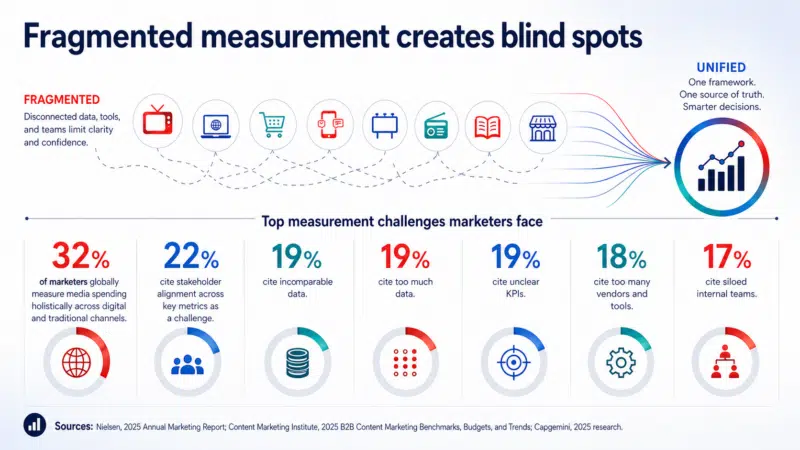
Capgemini’s 2025 study adds another challenge: The company said 39% of metrics used by marketers today are “less meaningful,” often tied to subjective metrics like impressions and reach rather than business results, and only 42% of marketers said they have the right metrics in place to measure long-term value.
What Marketers Should Watch For Next
One thing that remains unclear is the basic adoption model of UMM. The website presents it as a shared framework, but it is not clear whether the tool is offered as a paid product, an open framework, a licensed service, or something else entirely. We requested more details on the deployment and adoption model, but received no response.
Public documents suggest that the UMM is designed to complement, not replace, existing measurement tools and models. This makes it feel less like a standalone platform and more like an additional layer that could sit on top of the current planning and measurement infrastructure.
Your customers are searching everywhere. Make sure your brand introduces himself.
The SEO toolkit you know, plus the AI visibility data you need.
Start free trial
Start with

The bigger question is whether UMM will become a widely adopted planning standard or remain a Coca-Cola-led measurement model that other marketers can study but not easily replicate.
If it gains traction, it could be part of a broader shift toward multi-channel measurement systems aimed at unifying planning, reporting and budget allocation. If not, this can still serve as a useful example of how big brands are thinking about the fragmented problem of media measurement.



