
Marketers have wondered for years whether consumers are ready to buy thanks to AI. New research from Invoca suggests that this question has largely been answered. The bigger issue is whether brands are ready to meet customer expectations created by AI.
According to Invoca’s B2C Buyers Experience Report, consumers are increasingly comfortable with genAI and agents throughout the buying journey. At the same time, they have become less tolerant of slow processes, disconnected customer experiences, and poorly designed automation.
The result is a growing gap between what consumers expect and what many organizations can deliver.
Times when AI is better
For years, chatbots were often seen as barriers between customers and access to the information they wanted. Today, there are even circumstances in which AI is preferred.
They especially like it when they want a quick response. Nearly three-quarters said they would prefer to interact with an AI agent over a human if the AI could answer questions or resolve problems more quickly. But don’t try to pass AI off as human. More than 80% of consumers say it’s important for a brand’s AI to be clearly identifiable. They expect the information to be leaked. For brands, this is an inexpensive and highly reliable tactic to deploy now.
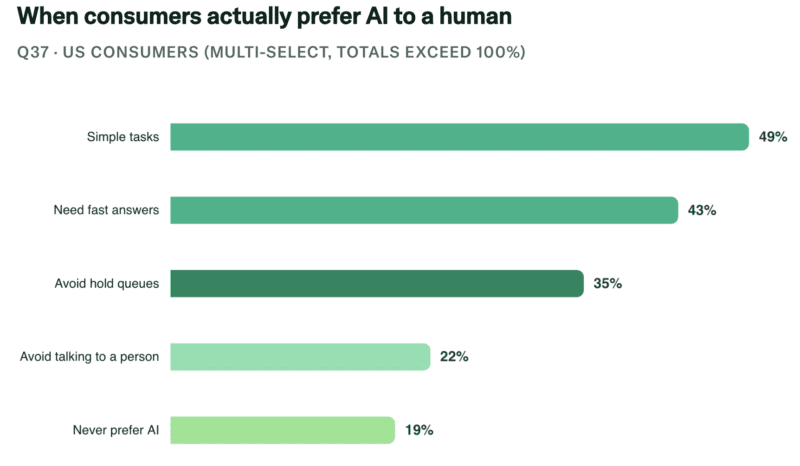
This finding highlights how buyer expectations have changed. Consumers no longer evaluate AI as a novelty. They rate it as a practical tool that saves time and simplifies decision-making.
For marketers, this means AI becomes another customer touchpoint rather than a separate technology initiative.
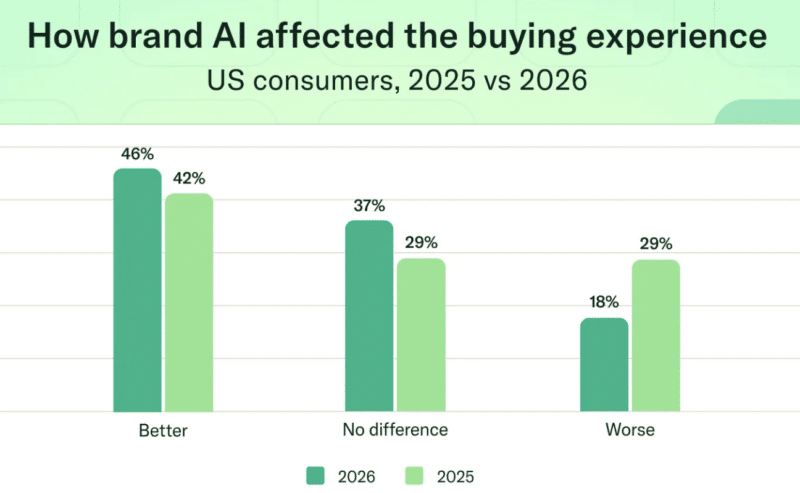
However, doubts remain. A year ago, 60% of U.S. consumers said they felt compelled to interact with a brand’s AI most or all of the time. This figure has only decreased slightly this year. Consumers are fickle, and while they are more accepting of AI assistance overall, more than 40% still feel less valued by brands that use AI to help them. It hasn’t changed much since last year.
When AI fails, consumers blame the brand
The study sounds a warning to companies rushing to automate customer interactions. Consumers see no difference between the AI agent and the company deploying it. The AI experience is the brand experience.

If AI provides inaccurate information, gets stuck in a loop, or fails to resolve a problem, consumers overwhelmingly hold the brand responsible. Invoca found that buyers blame companies nearly three times more often than the technology itself when interactions with AI go wrong.
This raises the stakes for marketing, customer experience and operations teams.
AI deployments require much more than launching a chatbot and connecting it to a knowledge base. Success depends on quality data, testing, governance, rapid design and continuous monitoring. What may look like a technical issue internally can quickly become a brand perception issue externally.
AI raises the bar for response times
One of the report’s most important findings concerns what happens after an interaction with AI.
As consumers become accustomed to getting responses within seconds from AI systems, their expectations of all other channels increase as well. When a prospect fills out a form, they want a response now. If tracking takes hours or days, marketers risk losing the opportunity entirely.
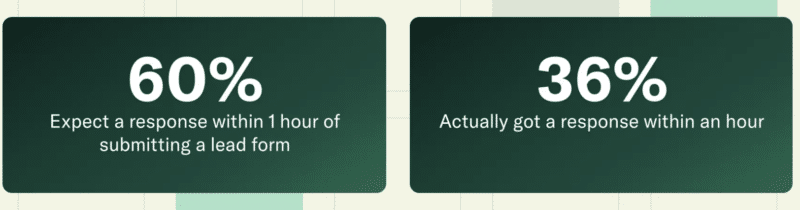
The expectation of immediate engagement extends beyond AI itself. Shoppers increasingly judge brands based on how quickly they respond to each touchpoint.
For organizations focused on demand generation, this means response speed can become just as important as lead volume.
The future is hybrid
Perhaps the most interesting finding is that consumers seem willing to forgive AI’s limitations under the right conditions.
Most buyers understand that AI can’t solve every problem. What matters is what happens next. Invoca found that 77% of consumers are more willing to use a company’s AI tools if they know they can easily switch to a human representative when needed.
In other words, consumers aren’t demanding fully autonomous experiences. They ask for flawless ones.
Frustration begins when customers have to repeat information, restart conversations, or wait for multiple transfers. They want AI to handle discovery, routing, and routine matters, while human experts step in when situations become more complex.
Your customers are searching everywhere. Make sure your brand introduces himself.
The SEO toolkit you know, plus the AI visibility data you need.

@media (maximum width: 768 px) { .headline-responsive { font-size: 30px !important; line-height: 1.3 !important; } }
This means that the most effective customer experiences may not be fully automated or fully human. They will combine the speed and efficiency of AI with the judgment, empathy and expertise that people still offer best.
For marketers, the lesson is simple. AI can accelerate customer acquisition and improve efficiency, but automation alone is not enough. The brands that win will be those that connect AI, operations and human support into a single experience that is fast, useful and seamless from start to finish.
The full report can be found here. (No registration required)
The position Consumers are ready for AI, but many brands are not appeared first on MarTech.



