

AI agents are supposed to automate marketing workflows at machine speed, but many martech platforms can barely support them. Behind the AI hype is a growing infrastructure problem: APIs designed for humans to click through dashboards are becoming a bottleneck, preventing autonomous agents from working reliably on modern marketing stacks.
A new public dataset from SaaStr — the community of SaaS founders created by Jason Lemkin — quantifies the problem for the first time. The SaaStr AI Agent API Report Card scores 152 B2B software APIs on six criteria that matter when an AI agent uses them:
- API design
- Support for events and streaming
- Authentication
- Rate Limits
- SDK quality and documentation
- Agent readiness (if the API is designed to be safely exploited by AI)
Each is scored from 0 to 10 to a maximum of 100, with letter grades ranging from A+ to F. Grades are based on independent assessments by three AI models: Claude, GPT, and Gemini. Think of it as a compatibility score for the AI agent era.
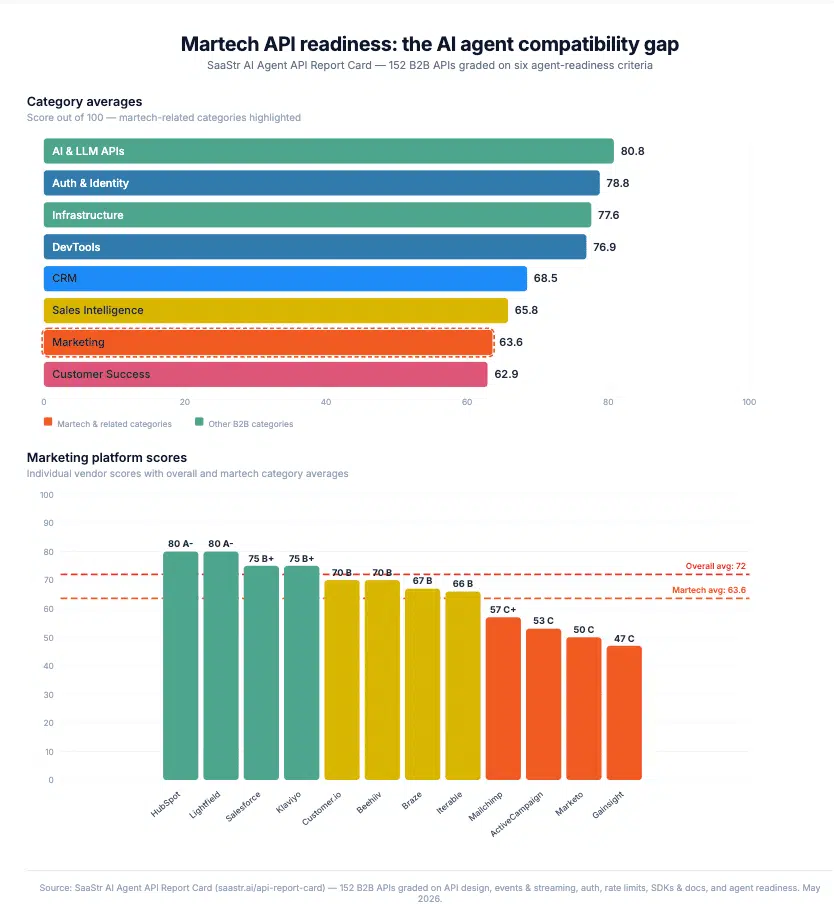
The results are sobering. The overall average is 72 out of 100, or a C+. But the infrastructure and development tools push the average up. When you look at the categories marketers rely on, the scores drop sharply.
The marketing API gap
Marketing APIs have an average of 63.6 out of 100. Customer success platforms have an average of 62.9. Sales intelligence tools have an average of 65.8. Even CRM, the most established category in the business software market, averages 68.5.
Compare this to AI and LLM APIs (80.8), Authentication and Identity (78.8), DevTools (76.9), and Infrastructure (77.6). AI tools are ready. The marketing platforms they are supposed to be working on are not.
Of the 57 marketing-relevant APIs in the report card, only five score 80 or higher, or an A- or better. That’s 9%.
HubSpot and Lightfield achieve a score of 80 (A-). Salesforce obtains a score of 75 (B+). After that, the marketing stack drops quickly: Klaviyo to 75, Customer.io to 70, Beehiiv to 70, Braze to 67, and Iterable to 66.
Next comes the tail.
Marketo scores 50 out of 100 – a C grade, tied for the lowest score of any API in any category in the entire report card. ActiveCampaign scores 53. Mailchimp scores 57. Gainsight scores 47.
“The bottom of the list is the real story,” Lemkin wrote. “These are the budget categories most directly threatened by agent-driven workflows. »
It is worth keeping in mind that letter grades are graded very kindly. Typically, getting an 80 on a test results in a B-, and anything below 60 is a failure.
What causes these scores to drop?
The report card divides each score into six sub-criteria. The weakest dimension is rate limits (overall average of 6.6 out of 10): most APIs were designed for humans clicking on a dashboard, not software making thousands of automated calls per minute.
But for marketing platforms in particular, the lowest dimension is agent readiness: 6.1 out of 10. This includes things like sandbox environments (safe places to test without affecting live data), standardized error messages, and consistent API behavior that prevents duplicate records when an action is retried. Without these elements, an AI agent cannot safely test, detect failures, or repeat operations without accidentally creating duplicate contacts, leads, or records.
Webhooks and event support are also an issue. Sales intelligence tools average just 5.9 out of 10 on webhooks, meaning agents have to repeatedly check for updates rather than being notified automatically. Hunter.io scores 7 out of 10 on webhooks, while Apollo scores 4.
The contrast with the top of the general ranking is striking. Stripe scores 97 (A+) with a perfect 10 in API design, webhooks, authentication, SDK and docs, and agent readiness. GitHub scores 92 (A). Anthropic gets a score of 90 (A). OpenAI gets a score of 90.
Positive points and exceptions
There are bright spots. HubSpot Spring 2026 Release delivered an updated API version and dedicated developer APIs for its Breeze AI agents – improvements that earned it an A- (80). Salesforce Agentforce 360 And Agent Scripting Toolbox stay competitive with a B+ (75). The software gets a significant boost here.
But these are exceptions. The majority of marketing and sales platforms fall into the B range: functional enough for basic automation, but with significant gaps that will frustrate more complex AI workflows.
What this means for practitioners
For practitioners evaluating their batteries, the bulletin provides a simple framework. Can your CRM securely retry a failed action without creating duplicate records? Can your marketing automation platform send updates in real time instead of waiting to be asked? Does your sales intelligence tool automatically alert you when lead data changes, or should your team proactively look for it?
If the answer to many of these questions is “no,” your stack has an AI readiness gap, even if the product looks great in a demo. A polished dashboard doesn’t mean the underlying API is designed for agents.



