

A flood is coming. A downpour of noise: more content, more channels, more AI-generated everything, moving faster than most teams can keep up. Somewhere in that volume, your customers are quietly drowning – overwhelmed, underserved, and a bad experience away from choosing someone else.
You’ve probably felt it in your team too. Another tool. Another sprint. Another quarter doing more with less. Productivity metrics look good from the outside. But inside, people are running on empty.
There is an old story about a man named Noah who, when faced with a catastrophic disruption, did not freeze or panic. He didn’t look for shortcuts or try to outsmart the storm. He built – with intention, with a clear purpose and with people he trusted. When the waters rose, the ark stood firm.
Leading brands are not adopting as much technology as quickly as possible. They build with intention: designing systems and experiences that protect people.
What follows is the case for building your ark – and a practical framework for doing it.
The hidden emotional tax that no one measures
Customer Obsessed Organizations Have Succeeded 49% faster profit growth and 51% better customer retention rates than their peers, according to Forrester. The gap between what customers need emotionally and what brands deliver comes down to design.
The pressure doesn’t just affect the customer.
- Power users of AI say it makes their overwhelming workload more manageable (92%), boosts creativity (92%), and helps them focus on their most important work (93%), according to Microsoft and LinkedIn Work Trends Index.
- Yet 60% of executives say their company lacks a vision or concrete plan for AI, meaning the very tool that could alleviate team burnout is underutilized.
This gap manifests itself in concrete ways.
For customers, this creates friction: too many choices, unclear navigation, and messages that don’t know where they are. They arrive with a question and leave with even more confusion. They feel neither seen nor helped.
For marketing teams, the impact is more discreet but just as serious:
- Decision fatigue disguised as strategy.
- Tool overload presented as an innovation.
- Burnout that looks like productivity, until it doesn’t.
- Fragmented workflows that drain energy faster than they produce results.
Brands that recognize these human challenges progress more quickly, retain the best talent, build greater customer loyalty and generate better business results. Get into what I call the sweet spot of wellness.
Your customers are searching everywhere. Make sure your brand introduces himself.
The SEO toolkit you know, plus the AI visibility data you need.
Start free trial
Start with

Where AI, empathy and design meet
The wellness sweet spot is when AI, empathy, and human-centered design converge, creating conditions where your customers and your team can think clearly, act confidently, and trust the experience they’re in.
It’s an architectural decision about how your entire marketing ecosystem is designed to make people feel. When its three pillars truly work together, four things become reality simultaneously:
- AI reduces waste and cognitive load in the experience, making things simpler.
- Emotional friction is intentionally minimized at every touchpoint.
- Marketing teams operate on a foundation of feel-good (and feel-good).
- Systems and workflows support human flourishing, not just throughput.

When these conditions are met, something changes. AI stops feeling like a disruption and starts functioning as a stabilizing layer – supporting, protecting and silently holding the system together. It manages the overflow. The ark continues to float.
AI as an invisible layer of well-being
Most marketers still think of AI in terms of what it does: automate, generate, optimize, analyze. These results are important, but they don’t tell the whole story. The more important question is how AI makes people feel when it does these things.
For customers, well-used AI is a guide that:
- Summarizes complexity without making it stupid.
- Narrows down choices in a way that feels helpful rather than manipulative.
- Anticipates what someone needs next and removes ambiguity from decision paths.
- Saving time – which is, in a very real sense, saving emotional energy.
For teams, well-deployed AI absorbs the work that burns people out the most: repetitive, reactive, and administrative work. This creates space for what the human brain does best: strategy, creativity, relationship building, and nuanced judgment.
When you build your marketing systems around that, the quality of production increases because the people producing it aren’t running on steam.
This is empathy on a grand scale. Not the kind that’s in a tagline, but the kind that’s built into the way your systems are structured and the way your content is designed to reach people.
What to Measure When You Start to Care About Feelings
This is where things get practical and start to get a head start. Most marketing dashboards show what happened: click-through rates, conversion rates, and time on page. These metrics are important, but they don’t explain why someone left or how they felt along the way.
Emotional measures help fill this gap by focusing on the conditions under which decisions are made. Psychology and neuroscience research shows that people make better decisions, build stronger brand relationships, and become more loyal when they feel clear, confident, and calm.
Here’s how traditional metrics map to emotional KPIs:
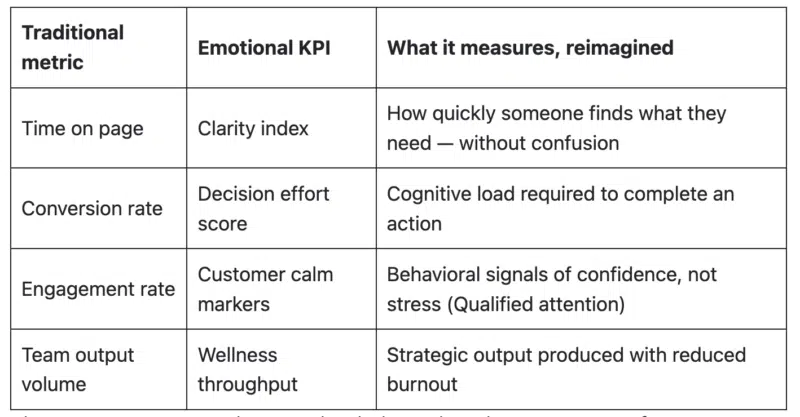
These are upstream indicators that help explain downstream performance. A low clarity rating often results in stuck conversion rates. A high decision effort score can lead to increased cart abandonment. Decreasing welfare throughput tends to result in average production from top strategists.
Brands that start following them now have an advantage over those that wait to respond.
See the full picture visibility of your search.
Track, optimize and win in Google Search and AI from a single platform.
Start free trial
Start with
5 Steps to Designing Your Well-Being Sweet Spot
A caveat before the roadmap: more speed and scale applied to a broken system won’t fix it. This will amplify whatever is wrong. These five steps are meant to be performed Before you push harder on AI adoption.
Step 1: Run an Empathy Audit
Where are customers confused? Are you hesitating? Exit? Map these moments using behavioral data combined with qualitative insights: customer interviews, session recordings, support tickets, research data. Focus less on what people clicked on and more on where they felt lost.
Step 2: Simplify for Cognitive Ease
Less choice. Simple language. Cleaner navigation. Each step you remove from a decision path is a small act of respect for your client’s mental energy. It’s generous. It’s designing with intelligence.
Step 3: Use AI as a Shepherd
Deploy AI to improve direction, clarity and confidence. Don’t push aggressive automation or create a sense of urgency. AI should make customers feel helped, not herded on. There is a difference and your audience feels it.
Step 4: Rebuild team workflows around energy
Check where your team’s cognitive energy is actually going each week. Identify work that is routine, reactive or repetitive and integrate AI into those gaps first. Protect hours that require human judgment, creativity and relationship building. These are the hours that generate real growth.
Step 5: Measure the sensations
Start tracking emotional outcomes as well as performance metrics. Start simple: add a post-interaction survey to a question.
Review search data for confusing signals. For example, an increasing volume of “how can I” or “why can’t I” phrases on your own site may indicate that your content is not answering questions before they are asked.
Monitor support ticket topics for friction patterns. A perfect measurement system is not necessary to get started. Looking at it, it does.
The future belongs to emotionally intelligent brands
In a market where almost every brand claims to be customer-centric and frictionless, the real differentiator is how people feel and whether systems consistently deliver on that promise.
Larger organizations do not rely on larger AI budgets. They align technology with clear intent, prioritize timely, empathy-driven content over volume, treat customer well-being as part of the brand promise, and protect their teams’ energy as rigorously as performance.
Creating value starts by protecting the people who create it. Noah did not survive the flood by ignoring or fearing it. He paid attention, acted, and built with intention – something designed to carry what mattered most: his people, his purpose, his peace, and his future. This is the kind of leadership that the present moment demands.
You don’t have to solve this problem alone. The tools are here. The frame is yours. The decision is whether to build before the pressure hits or react once it is already underway.



