
- By
Imagine opening your browser in a few years. You type a question into a search bar, but instead of clicking through blog posts, guides, or news articles, an AI instantly tells you exactly what you need: personalized, completely up-to-date, written in your preferred style, even up to date on your past questions.
You don’t go through ten pages of results. You don’t go through mediocre blog posts stuffed with keywords. You don’t bother with half-finished YouTube tutorials. Why would you do it? The AI version is faster, more accurate and designed especially for you.
This future is not science fiction: it is already happening. AI is starting to flood the internet with endless streams of competent, personalized, disposable content. And in this flood, most static, man-made content will drown.
But not everything. Some static works will survive. In fact, some will prosper. Yet the bar for survival will be much higher than ever. If you’re a content creator today – whether you write, design, film, code or illustrate – this should help you get back on your feet. Because what’s coming is a big gap: only the spectacular will endure.
AI flood era
For decades, the Internet has been an open playing field. Anyone could write an article, post a video, or share their art, and there was always at least a chance it would find an audience. Effort and skill were important, but even modest work could carve out a niche.
AI changes this balance. Its strength lies in content production “sufficient.”
- A concise explainer
- A list of tips
- A product review
- A quick video script
Individually, none of these results is remarkable. But they are fast, cheap and can be generated infinitely. And unlike static human-created content, they can be constantly updated, personalized for each viewer, and delivered instantly.
Why read a three-year-old blog post about “Best Cameras for Beginners” when an AI can generate one based on your exact budget, location and preferences – right away?
It’s the AI flood: a never-ending river of content that washes away anything that isn’t exceptional.
Two-speed Internet
The best way to understand what’s coming is to imagine the Internet divided into two distinct layers – each with its own rules, its own purpose, and its own type of content.
Level 1: The surface layer of AI
This is the everyday Internet that most people will interact with most of the time. It is dynamic, disposable and perfectly suited to all your current needs.
Features:
- Short-lived: Created instantly, used once, rarely saved
- Adaptive: Personalized according to your preferences, context and background
- Infinity: Generated in infinite quantity, without shortage
Examples:
- Instead of Googling “how to cook salmon,” you ask an AI assistant – and it generates a step-by-step recipe tailored to the ingredients you already have in your fridge.
- Instead of reading five different news sites, AI provides you with a real-time briefing tailored to your political orientation, reading level, and even mood.
- Instead of sifting through a dozen reviews, you ask the AI to summarize them into a single personalized recommendation.
The surface layer is like a water jet: always moving, always refreshing, always shaped according to your needs. He doesn’t care about permanence, he cares about utility, immediacy and scale.
Level 2: the upper human layer
However, some creations will remain above the surface, those that are too precious, too moving, or too monumental to be carried away by the AI flow.
Features:
- Sustainable: Created to last, referenced again and again
- Spectacular: Not only adequate but profoundly original, moving or revolutionary
- Rare: Difficult or even impossible for AI to replicate with the same quality
Examples:
- A novel that defines a generation
- An in-depth investigation that reshapes public understanding of an issue
- A film, game, or work of art designed in such a way that it resembles a cultural event
- A website designed not for SEO, but as an immersive artistic experience – something people link to because it it looks like a place
These pinnacles are like cathedrals: rare, impressive and destined to stand the test of time.
How the two layers work together
The AI surface layer will manage the daily flow: questions, summaries, guides, recommendations, on-demand entertainment. This is the default for the utility.
The upper human layer will provide the benchmarks to which the AI layer often refers: the sources, the masterpieces, the anchor points of culture and knowledge.
Think about it like this:
- AI is the news tickerconstantly updated.
- The human summits are the history books And masterpiecespreserved because they matter.
Both layers will exist, but they will fulfill different roles. And for creators, the crucial question is: What layer are you building for?
The profitability filter
Spectacular content doesn’t just happen. It takes time, energy and resources. Which means it must be profitable, or at least sustainable, to survive. This profitability filter will force static, human-created content into narrower pathways.
- Blockbusters
Large-scale projects which attract the greatest number of people and which require significant investments but promise significant returns. Think Marvel movies, AAA video games, or Netflix documentaries. In the future web, this could also mean massive multimedia reporting projects or heavily produced YouTube epics. - Sponsorship and luxury niches
Work that survives because it is supported by wealthy donors, institutions or grants. Renaissance painters had patrons. Universities fund niche research. In the age of AI, this could extend to independent journalists supported by nonprofits, or avant-garde artists funded by patrons hungry for authenticity. - Community economies
Independent creators who survive not by appealing to everyone, but by finding a deep resonance with a small audience willing to pay. Patreon musicians, Substack writers, indie developers, or niche YouTubers with loyal followers.
What is disappearing? The middle. The occasional blogger, the competent but mundane tutorial channel, the freelance writer who publishes SEO articles. AI will do this job better, faster and for free.
The future of static content is a bar: giant blockbusters on one side, niche-backed passion projects on the other. And a hollow middle between the two.
The shrinking of the show
This profitability filter creates a narrowing of what is considered “spectacular.”
- Wide show: Projects that are profitable because they appeal to millions of people. These become cultural blockbusters – the few works that everyone knows.
- Niche shows: Spectacular projects for small communities, made sustainable by loyalty and patronage. These become subcultural gems – treasures for the few who care deeply.
The Internet is losing its sprawling middleman, where millions of semi-good creators lived. In its place we get imposing monuments and small shrines.
It is the same form as the modern music or film industry:
- Global pop stars at the top
- Independent scenes survive in pockets
- And the rest drowned in algorithmic playlists and fillers
What this means to you, the Creator
If you’re a content creator today, this shift is both terrifying and enlightening.
- Good enough is not enough
If your work could be replicated by AI, assume it could. The bar goes from “decent” to “exceptional”. - Build a ditch
What can’t AI simulate? Your voice, your story, your relationships, your lived experience. The authenticity of who you are becomes your defense. - Choose your path
– Aim blockbuster status: producing on a scale and with a polish that few can match.
– Or engage in a niche: Cultivate a community that values you enough to support you.
– Straddling the middle – competent but banal – will no longer work. - Think about monuments
Instead of chasing clicks with throwaway posts, think in terms of lasting impact. What can you do that feels monumental? Something that people come back to, refer to, preserve.
The creators who thrive will be those who adopt this filter – who stop trying to do what AI does best and start doing what only humans can do spectacularly.
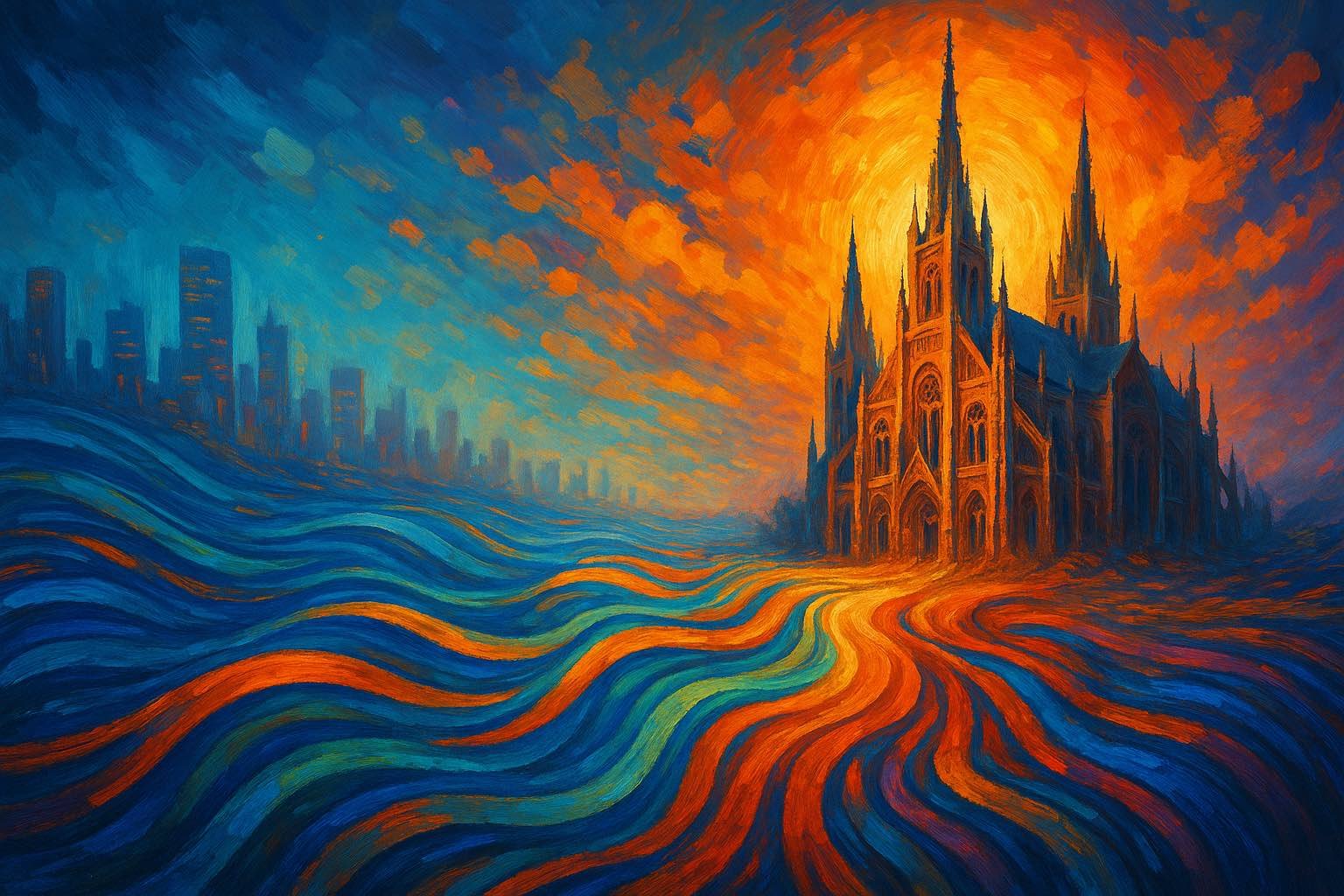
Internet as cathedrals and currents
The Internet of the near future won’t look like the one you grew up with. It will be divided:
- Currents — AI’s infinite, ephemeral stream of content flowing around us at all times.
- Cathedrals — monuments built by man: rare, breathtaking and durable.
Most designers today live somewhere in between. But this happy medium is disappearing. Either you will learn to ride the currents (using the AI yourself, feeding the stream), or you will dedicate yourself to building cathedrals – static works so extraordinary that they cannot be ignored.
The final preview
There is a paradox here worth savoring. AI, by flooding the world with adequacy, could actually purify human creation. This will clear away the clutter of mediocrity, forcing us to reach greater heights.
That doesn’t mean it will be easy. Many creators will disappear in the flood. Others will survive, but only by adapting to the new economy. But for those who dare to aim for the monumental – the spectacular – the next Internet might actually be more rewarding.
Because in a world where machines do everything right, the only content that matters is what humans can do. spectacularly.
Related reading:

Source link



