
- By
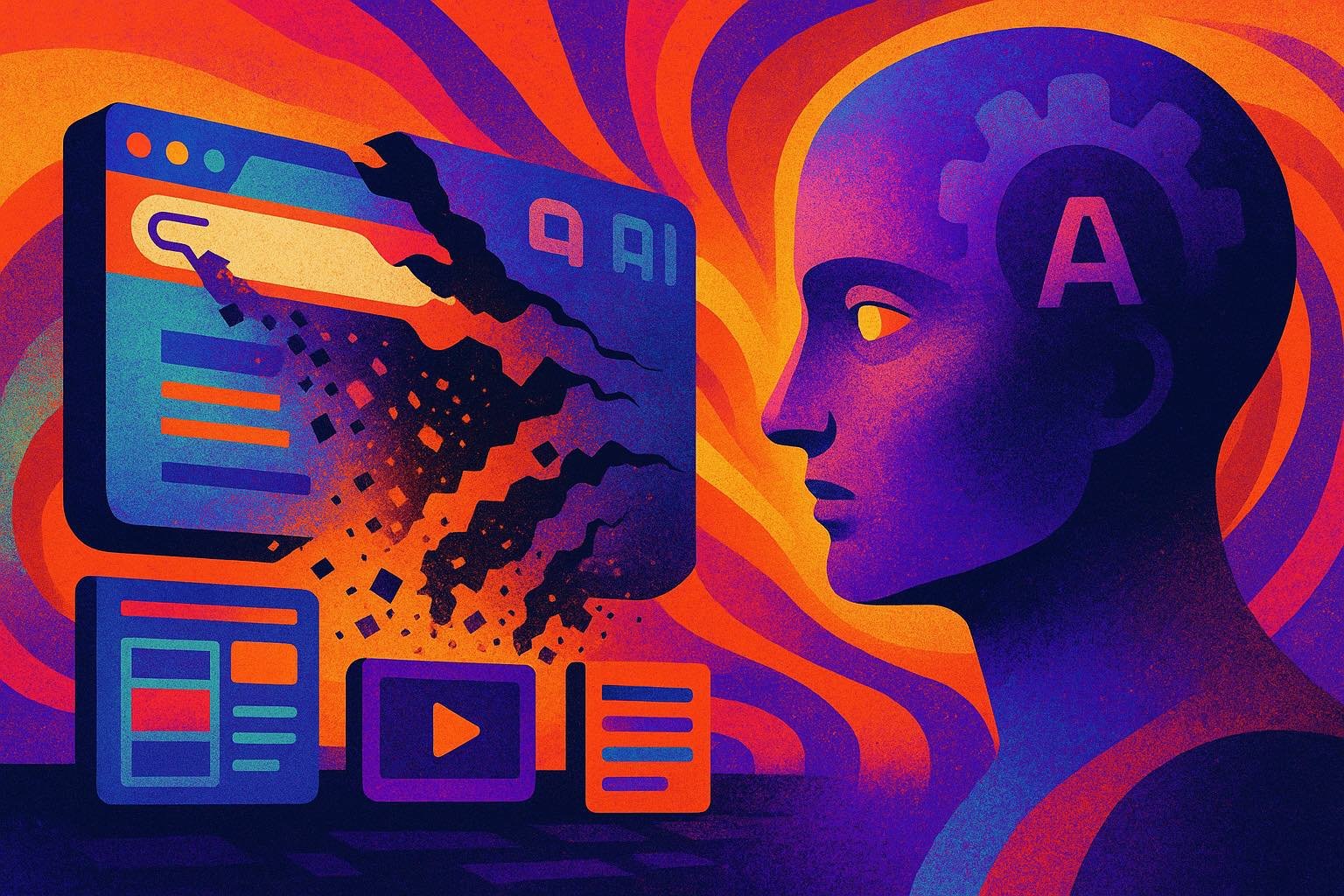
In a moment of stunning irony, the same tech giants that are investing billions in AI – Google, Microsoft, Meta – are also funding what could be the slow collapse of the very ecosystems that gave them their power.
Generative AI promises to create knowledge, creativity and productivity free, personalized and instantly available. But in doing so, it undermines the value of human content, creative work and, perhaps most seriously, the fundamental architecture of the modern web: Google search.
Let’s take a closer look at how AI isn’t just disrupting creators: it’s devouring the mechanisms that once made the Internet sustainable for publishers, developers, and creators.
🔍 1. AI is replacing Google search, and it’s a disaster for the web
For more than two decades, Google Search is the beating heart of the Internet. This attracted attention. It rewarded relevance. It was the main way people discovered websites and the main way websites made money.
But now Google is actively replacing traditional search results with AI-generated summaries— short, neat answers extracted from the web and displayed directly on the results page. These “AI previews” promise a faster, cleaner experience.
The compromise? No clicks. No traffic. No income.
The AI does not send people to your site. He answers their question and moves on.
It is catastrophic for:
- Online publisherswho rely on search traffic for their advertising revenue.
- Niche bloggers and independent mediawho rely on visibility.
- Businesseswhose conversions often start with a Google search.
By collapsing the discovery mechanism, AI cuts off the oxygen supply to the open web. And since the AI is trained on the content it now replaces, this creates a catastrophic loop:
AI Powers the Web → AI Reduces Traffic to the Web → Less Incentive to Post → Less New Content to Power the AI → Worse AI → Diminishing Returns for Everyone.
It’s a digital ouroboros…the snake eats its own tail.
📰 2. Online publishers: content without a marketplace
Without search traffic, what are online publishers left with?
- Social networks? Highly paid, unpredictable and increasingly algorithm-based.
- Newsletters? Great for loyalty, but limited discovery.
- Direct traffic? Requires a massive, established brand, something few can achieve without research.
AI makes high-quality, SEO-optimized content virtually worthless. You could write the best guide to anything on the Internet, but if an LLM ingests it, rewrites it, and serves as an answer, you never see the benefit.
The more useful your work is to the AI, the less useful it becomes to you.
The result? Declining revenues, layoffs, closed websites and a chilling effect on digital publishing.
💻 3. Web developers: automate without work
AI also writes code efficiently, quickly and increasingly accurately.
Web developers are now faced with:
- Customers using AI to build sites without them
- Tools for cloning entire interfaces or entire applications from sketches
- Reduced demand for junior roles and independent assignments
At the same time, websites created by these developers see less traffic– because AI keeps users on the search page. Even beautifully constructed sites can disappear into obscurity.
Why create a site if no one visits it? Why visit a site if the AI has already answered your question?
🎥 4. YouTube Creators: The Last Human Faces – For Now
YouTube creators, long considered more insulated from disruption due to the inherently personal nature of video, are now seeing the first signs of a replacement.
- AI tools can generate realistic avatarsengaging voiceovers and scripts.
- Future tools will create entire videos:emotional, convincing, personalized– without any human involvement.
- AI can already analyze watch history to create perfect content loops based on dopamine.
In the coming years, YouTube could be flooded with hyper-optimized AI-generated channels. Some will not even hide their synthetic nature: they will simply be better. More consistent. Cheaper. Sharper.
The human creator becomes a high-end novelty, not the norm.
Once again, the feedback loop continues: AI monitors what works well → recreates it at scale → saturates the market → devalues human originality.
🧨 The collapse loop: a future without incentives
Here is the scary feedback cycle that is now taking shape:
- AI consumes content of the Web to learn.
- AI answers questions which generated clicks.
- Websites are losing traffic and therefore income.
- Publishers stop creating content.
- AI quality declinestrained on less and less fresh material.
- Search becomes less usefuland we are heading towards digital decadence.
This is not creative destruction. It is destruction of value without replacement.
🧭 And then?
Forget the utopian promises of AI creating new jobs, new industries or a thriving creative class. In reality, the Web is heading towards greater centralization, consolidation and access control.
In the absence of the possibility of discovery through research, power consolidates around those who already have what matters most: an audience.
- Big influencers continue to grow as algorithms prioritize engagement and volume over novelty or depth.
- Large media companies survive because they can make deals, pursue lawsuits, and build direct pipelines to platforms.
- Technology platforms becoming the Internet itself, controlling access, attention and monetization end-to-end.
Small creators? Independent publishers? Solo developers? They face a steep cliff. Without research aimed at leveling the playing field, there is no path to organic growth: no viral burst moment, no “10x content” strategy, no emergence from obscurity.
The game now belongs to those who have already won.
The promise of the early web – an open, meritocratic space where everyone could attract attention based on their value – is disappearing. AI is not just disrupting industries. This strengthens the winners and erases the rest.
And it goes quickly.
🤖 The essentials
AI promises abundance, but it delivers scarcity: of jobs, of incentives, of sustainability. The very companies building this future may soon discover that they have invented the ultimate disruption:
A technology that gives everything away for free and doesn’t let anyone profit.
Related reading:




