
- By
Think about how much the way we search for things has changed over the years.
Back then, you typed something into Google and crossed your fingers that you’d get a decent link buried somewhere on page 1. Then YouTube came along, and suddenly many of us stopped typing into Google altogether: we went straight to YouTube. For what? Because sometimes it’s easier (and more fun) to see the answer in action rather than reading a wall of text.
AI has now entered the scene. More and more people are ignoring Google (and even YouTube) and going directly to AI. Why bother looking through the results when you can get a clear summary in seconds, ask more questions, and have a real back-and-forth conversation?
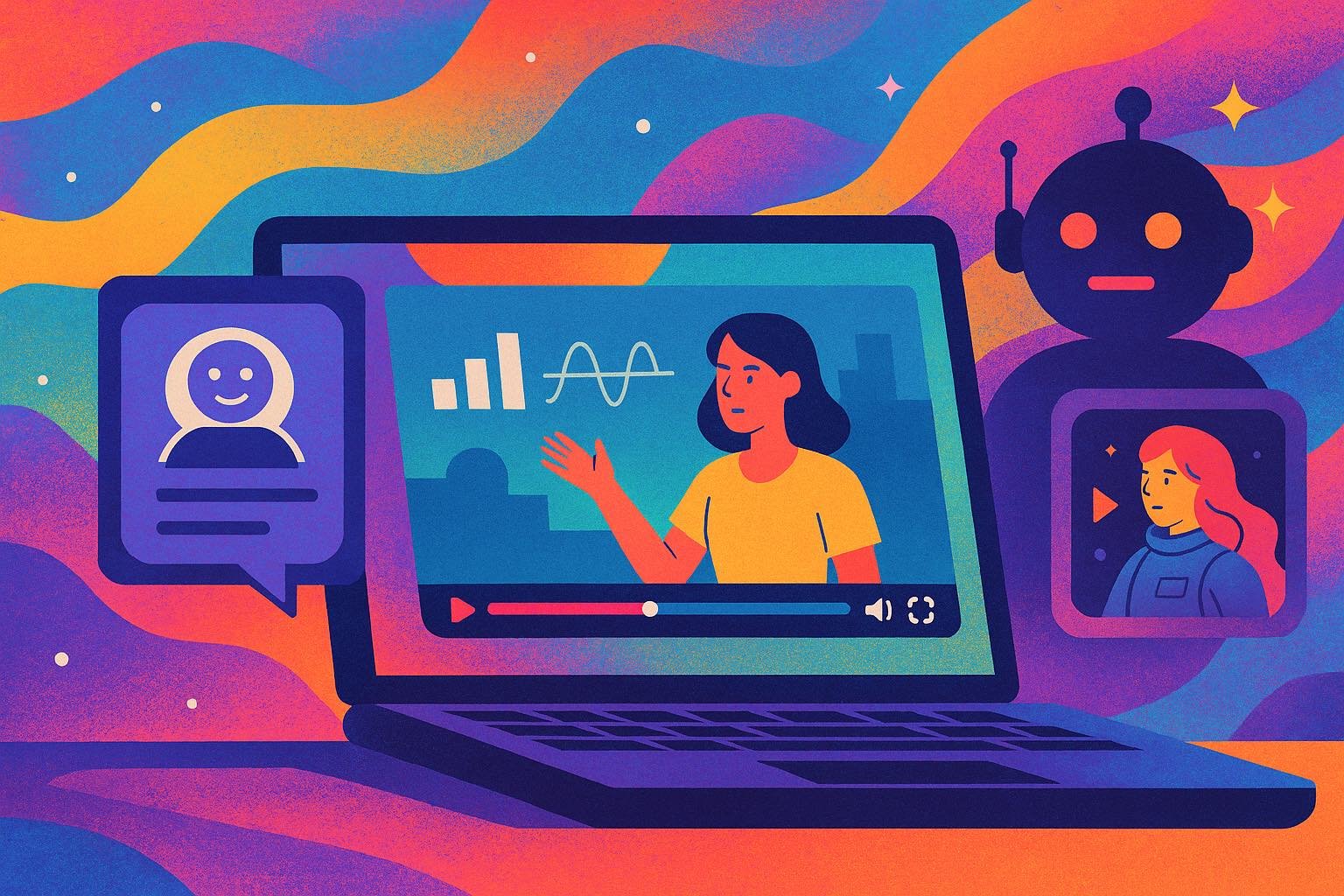
So here is the obvious next step: an “AI YouTube”. You ask a question and instead of a text answer, you get a personalized video that explains it, shows it, and even adapts to what you say next. No need to wait for a human to download something. No need to click through ten tutorials to find the one that matches your level. Just an instant, interactive and personal video.
Sounds wild, right? But it’s closer than you think.
Why AI + Video is the perfect combination
Some things are just better explained with video:
- Fix a leaking faucet → you want see where the washer goes.
- Eigenvectors → you want arrows moving around a grid, not an algebra block on a forum.
- Fold a napkin into a lotus → you want slow hands and over-the-shoulder angles.
YouTube exploded because it made learning and discovery visual. AI has exploded because it makes things fast, personal and interactive. Put them together and suddenly the answers aren’t simple say you—they come true in front of you.
A day in the life with AI video responses
1) DIY at home at 8:10 a.m.
You: “My kitchen faucet drips every 20 seconds. Show me how to fix it.”
AI: Generates a 90-second video of a sink like yours, showing exactly how to turn off the water, replace the washer, and close it again.
You: “I don’t have that hex wrench.”
AI: “No worries, here are two other methods” and regenerates this part with different tools.
2) Learning during lunch break at 12:35 p.m.
You: “Explain eigenvalues and eigenvectors like I was 15.”
AI: A four-minute animated explanation with moving grids, arrows and metaphors.
You: “Now show me the formal version.”
AI: Return the second half with notations, proofs and a concrete example.
3) Shopping at 6:05 p.m.
You: “Compare the best commuter e-bikes under £1,500 for rainy London.”
AI: Creates a side-by-side review video with four models, highlighting fenders, lights, hub vs. mid-drive, and climbing performance.
You: “I live on a hill; only display halfway with built-in lights.”
AI: Instantly swap irrelevant bikes and simulate a climb with others.
4) Be a parent at 7:40 p.m.
You: “Create a bedtime story about a shy otter who learns to surf, with colors and gentle rhymes.”
AI: Produces a gentle illustrated read with narration.
Your child: “Now the otter is a space explorer!”
AI: Refreshes the last two minutes, keeping the same art style but launching the otter into space.
5) Sci-Fi evenings at 10:15 p.m.
You: “Give me a filler chapter of Galactic Odyssey to tide me over until the new episode comes out next Friday.
AI: Launches a 7-minute side story set between last week’s cliffhanger and the upcoming arc. Same art style, same voice cadence, clearly marked as “AI-Generated Bonus Content”.
You: “Focus more on the engineer, she never gets enough screen time.”
AI: Restores the middle section in a tense sequence in the engine room, giving your favorite supporting character their moment.
What could this type of platform look like?
Imagine a simple chat bar. You type or speak, and a video appears:
- The videos come with chapters that you can skip between. If you don’t like a part, that chapter regenerates with your edit.
- On-screen overlays let you pause a chart, click on a tool to learn more, or view a shopping list.
- You can choose “styles”: a BBC documentary tone, a relaxed workshop feel, or even anime.
- The video may stop to ask you something: “Do you have copper or PEX pipes?” » – and direct the story accordingly.
- A side panel displays quotes and references so you know where the facts come from.
For creators, there would be a “director mode”. Upload assets, set the tone, provide scaffolding, and let the AI render multiple versions. Creators could even sell “style packs” (voices, avatars, animation styles) so others could use them (with credit and a share of the revenue).
Technology (without getting too nerdy)
- Understand your question: The AI breaks it down into steps and decides what visuals and storytelling it needs.
- Gather assets: It extracts licensed footage or stock models and generates the missing parts on the fly.
- Narrative rendering + visuals: AI voices (that sound natural), animations, overlays, all synced together.
- Deliver quickly: You see the first frames in a few seconds, and the rest is streamed as the rendering is complete.
The follow-up questions don’t replay the entire video, just the chapter you edited.
The big questions: trust, safety and “Is it real?” »
- Everything should be watermarked and labeled as AI-generated.
- Facts should be accompanied by sources you can verify.
- Dangerous items (like electrical wiring or medical advice) should either be blocked or routed to appropriate human-approved guides.
- There needs to be transparency about what is AI and what is real, so that people are not misled.
What about human creators?
This doesn’t mean the end of YouTubers. But this will shake things up.
- Basic “how-to” content will be commoditized. Why watch a 12-minute tutorial with ads when you can get a personalized 90-second guide to AI?
- But humans have something that AI can’t simulate: charisma, personality, storytelling, lived experience. People aren’t just looking for information, they’re looking for the creator.
- New roles will emerge: “prompt directors,” “style pack artists,” and “curators” who build learning paths using AI video as building blocks.
Business models
- Announcements: Context sensitive but clearly labeled.
- Subscriptions: Best quality, no ads, premium styles.
- Affiliate links: Perfect for buying guides or DIY tools.
- Business plans: Private AI video responses for company manuals and training.
The future of “research”
We are talking about SEO—Search Engine Optimization. But in a world of AI video responses, we’ll talk about VEO: video engine optimization.
This means:
- The design suggests that your style or pack is best suited.
- Create short, modular video “atoms” that can fit into many responses.
- Build credibility by always showing sources.
- Create interactive hooks that keep viewers engaged.
Where will it stick first
- Customer Support (“My Router is Flashing Orange, What Now?”)
- Shopping (“show me a demo of this stroller versus that one”)
- Education (“explain derivatives in three different ways until I understand”)
- Daily procedures (cooking, DIY, repairs, coding basics)
And yes, entertainment too, like this example of a filler episode.
So… When?
This is not a distant vision. The elements already exist: text-to-video conversion models, voice AI and reasoning engines. It’s just a matter of putting them together to make a smooth product.
Within a year, expect pilot projects: AI video responses for help centers, stores or niche tutors. Two years from now, don’t be surprised if YouTube itself comes up with a version.
Final Thought
For decades, the pattern was: you ask a question, then go looking for someone who has already given the answer. In an AI YouTube world, you ask and the answer comes true— personalized, visual and interactive.
It will not replace human creativity or storytelling. But that will Raise the foundation of what we expect when we want to learn, fix, or explore something.
So the next time you type a question into Google or YouTube, imagine instead that a video is just starting to create for you. It’s the future. And it’s not far.




